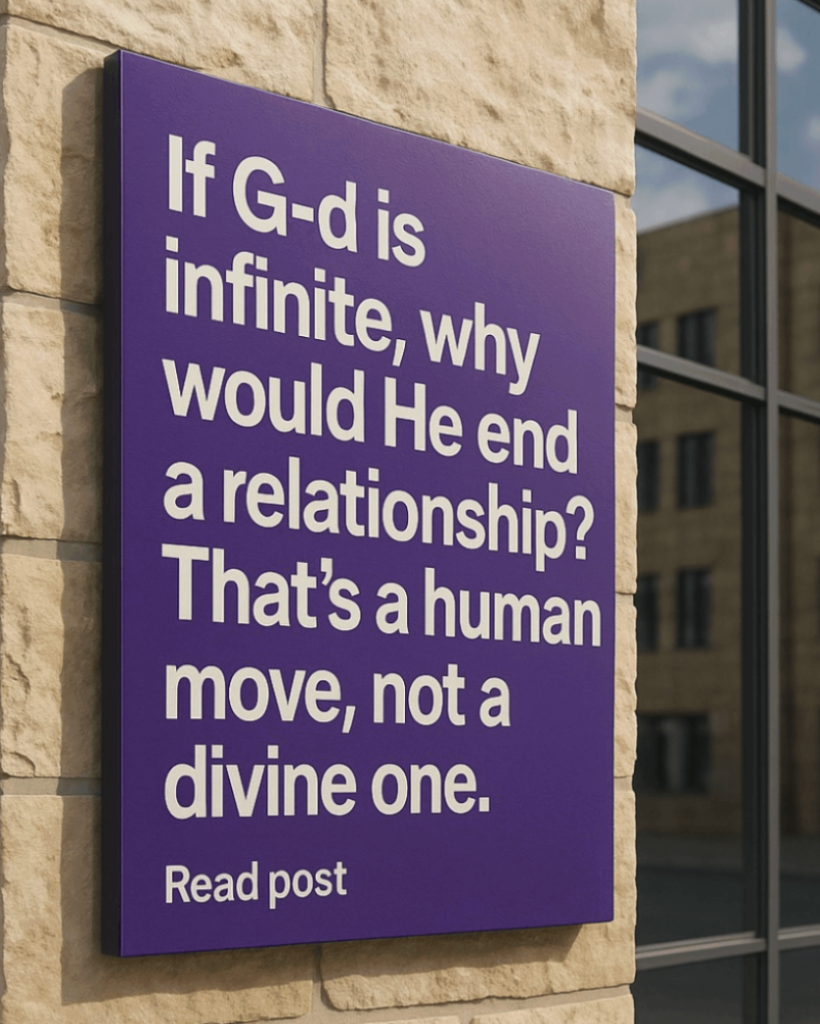
“If G-d is infinite, why would he He end a relationship? That’s a human move, not a divine one.”
That question stopped me mid-scroll. So much debate. So little clarity. Here’s the simple walk-through.
Islam’s view The Qur’an calls Jesus (ʿĪsā) a prophet and messenger. That’s written belief, not psychology.
Judaism’s view
 Prophecy ended with Haggai, Zechariah, Malachi — meaning no new prophets until it returns in the future.
 No changing the Torah (Hebrew Bible) — don’t add or subtract.
If it could change, G-d’s wisdom (ability to see the big picture) wouldn’t be eternal.
 Rambam: Anyone who permanently changes the law isn’t a true prophet — because truth doesn’t expire.
 No intermediaries: Worship/prayer go only to G-d — an infinite Being doesn’t need go-betweens.
 Miracles ≠ new laws: Wonders prove nothing if they break Torah.
The test is loyalty, not spectacle. Different texts → different rules. Ready for the big picture?
Who could be a prophet?
Rambam’s bar (jewish law):
Great wisdom, Mastery of character — not ruled by ego or impulse. Not ruled by impulses – inner freedom keeps the message pure.
(Notice: character > charisma.)
Prophecy vs. Jewish law (why both matter)
Prophecy = revealing Hashem’s (G-d’s) infiniteness, the wide-angle, big picture.
Halacha (jewish law) = hearing G-d step by step, detail by detail.
Both are critical:
Prophecy shows the horizon. Halacha (jewish law) shows the next step.
A door re-opening Rambam teaches prophecy will return when we’re ready. Many see Kabbalah as a first spark of that return. What if the pilot light is already on?
The humility of G-d (and divine justice) Saying G-d “ended” His covenant treats Him like a human who gets fed up. But His humility is beyond imagination. He doesn’t abandon. He sustains.
A loving parent would never give a child eternal punishment.
Jeremiah pictures Rachel weeping for her children: “A voice is heard in Ramah… Rachel weeps for her children.” (Jer. 31:14–15)
G-d answers: “Restrain your voice from weeping… there is reward for your work… your children shall return.” (Jer. 31:16–17)
Midrash: Rachel’s selfless mercy was accepted, because she fixed something that she could fix.
What’s happening? What if judgment is rehab, not exile?
The takeaway:
1. Islam: Jesus is a prophet by Qur’anic revelation.
2. Judaism: Claiming to change Torah (Hebrew Bible) or redirect worship disqualifies prophecy, miracles don’t override this.
3. Prophecy: It paused… but will return.
Learning kabbalah/chassidus is part of the preparation.
4. Compassion: An infinite G-d doesn’t do endless torture; justice aims to repair.
Your turn:
Does a G-d who never abandons change how you see prophecy, and justice?
#Prophecy#Jewishthought#interfaith#morality