A person says: “I have gifts, but they were given to me. If someone else had my abilities, maybe they would do even more with them.”
That is humility. Real humility does not make a person disappear. It makes a person more compassionate and more honest. More able to listen. More able to care. More able to have boundaries.
But there is another experience that can look like humility from the outside, while feeling much more painful on the inside. A person feels unseen. Unimportant. Missing. Far away. Not enough.
They may look quiet.
They may look agreeable.
They may look humble.
But inside, they are not feeling peaceful.
They are feeling erased.
On its own, that feeling is not holy. It can turn into shame. It can make a person think:
“I do not matter.”
“I am not wanted.”
“I am too far gone.”
“I have been forgotten.”
That is why lowliness needs repair. Because feeling unseen does not automatically make a person open to the Creator. Sometimes it does the opposite. Sometimes it makes a person people please, because disagreement feels too scary. But people pleasing is not humility. Humility includes compassion and boundaries. People pleasing abandons boundaries to avoid fear.
Sometimes feeling unseen makes a person avoid honest conversations, because discomfort feels unbearable.
Sometimes it makes a person become arrogant, because feeling unimportant is too painful.
Sometimes it makes a person need control, approval, or the feeling of being right.
These are ways a person protects himself from the pain of feeling unseen. But Chassidus explains something very deep: Sometimes the old way of experiencing yourself has to fully move out of the way before something truly new can enter.
Not improved.
Not updated.
Not a slightly better version of the old.
New.
That is the secret of the moon.
Before the lunar new month, the moon disappears. It becomes hidden.
Empty.
Absent.
But that disappearance is not the end of the moon. It is what makes the new moon possible. The old light has to go away completely so a new light can appear. And the prophet Isaiah describes the final repair of this relationship:
“And the light of the moon shall become like the light of the sun.”
— Isaiah 30:26
The moon begins as a receiver. It has no light of its own. But that does not make the moon worthless. It makes the moon able to receive. And in the future, the moon’s receiving will be so repaired that its light will become like the light of the sun. Meaning, we will notice how the receiver is also great.
Not because it stopped being a receiver.
But because receiving from the Creator is not weakness.
Receiving from the Creator is its own greatness.
This is not just a lesson about the moon. It is a lesson about the human being.
The Creator and man have nothing in common in essence.
The Creator is the source of existence. “If everything that exists were dependent on something else for existence, nothing would ever exist. There has to be one cause of existence” — based on a teaching of the Rambam in Guide for the Perplexed
Man is created, limited, dependent, emotional, and changeable. So the relationship cannot be based on sameness. It has to be based on receiving. And a relationship with the Creator begins with awe.
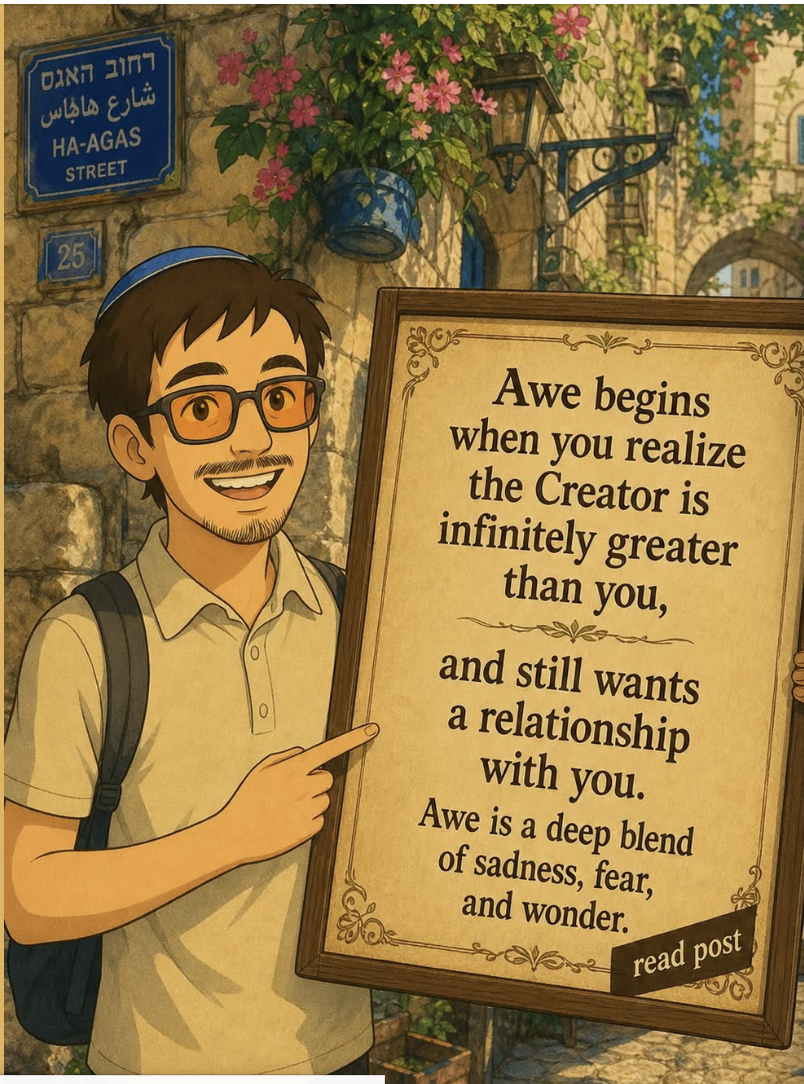
Awe is not just fear. It is a deep blend of sadness, fear, and wonder.
Sadness, because you feel how far from his goodness and limited you are.
Fear, because you sense that you are standing before something infinitely greater than you.
Wonder, because the Infinite Creator still wants a relationship with you.
Deeper joy is felt after awe because you feel connected.
Expressing appreciation for your gifts deepens felt awe. Through that awe, a person says:
“I am not the source. I am not here to replace the Creator. I am here to receive from Him, express His will, and become a channel for His goodness.”
That is not self hatred. That is not weakness. That is relationship and responsibility. Because the world was built with giver and receiver.
Soul and body.
Light and vessel.
Sun and moon. And light does not only mean brightness.
As Rabbi YY Jacobson explains:
“Light is a metaphor for the Creator’s desire to be perceived.”
That means the vessel is not just holding information. The vessel is holding revealed relationship. The Creator wants to be known. The created being becomes the place where that desire can be received, felt, and expressed.
But this only becomes healing when a person believes the Creator is good. Because if you feel unseen and you do not believe you are still loved, then the empty space feels like rejection. It feels like proof that you have been forgotten. It feels like distance with no way back.
But if you believe the Creator is good, then the empty space can mean something else.
It can mean: “I am not being erased. I am being invited back.”
“I am not unloved.
I am being given room to return.”
“I am not forgotten. The place where I feel unseen/missing can become the place where the relationship begins again.”
That is why feeling unseen and being remembered are connected.
When you feel unseen/missing, you may think:
“I must not matter.”
“I must be forgotten.”
But in a good relationship, absence does not mean rejection. Absence makes the relationship more noticeable.
When someone you love is not at the table, the empty seat makes you notice them more. So when a person feels unseen by the Creator, the danger is shame. But if they believe the Creator is good, the feeling can become something else.
“I want to return.”
The repair is believing:
“I am still loved.”
“The relationship is not over.”
Then the place where you felt unseen becomes the place where you long to return. The empty space becomes room to receive. But only because the Creator is good.
Only because even when you feel far away, you are still loved.
Only because the relationship was never destroyed.
It was waiting to begin again in a deeper way. This is one of the hidden benefits of exile. Exile can make a person feel unseen, unimportant, and forgotten. That pain is not the goal.
But when it is repaired, it can teach a person something comfort could never teach:
“I am not self made.
I am not my own source. I was created to receive, to serve, and to become a channel.” And even deeper:
“I am not just useful to the Creator.
I am chosen by the Creator for relationship and responsibility.” That is what exile can reveal. Not just that you need the Creator. But that even in a body, even in distance, even in a world where you can feel unseen, the Creator still chooses you for relationship.
The empty space is no longer shame. It becomes room.
Room to receive.
Room to be renewed.
Room to feel chosen.
Room for a light that could not enter while self protection (survival mode like people pleasing, narcissism or avoidance) was filling the space.
So there are two levels of opening. The first level is:
“I am open because I want to receive.”
That is already important. It means a person recognizes they need help, wisdom, direction, strength, and light from beyond themselves.
But there is a deeper level.
“I am open because there is Someone to be open to.”
That is not just openness for the sake of getting something. That is openness as identity.
My whole life is not self made.
My whole life is here to be emotionally and physically available to the Creator. That is the deeper repair. At first, the person feels unseen and unimportant. But after repair, the unseen place becomes longing.
The longing becomes openness.
The openness becomes receiving.
The receiving becomes relationship.
And the relationship brings new light. This whole meeting between giver and receiver only works because the Creator wants it to work. A finite human being does not naturally have access to the Infinite.
We are not close by nature. We are not the same category. But the Creator chose that our actions matter to Him.
He chose that when a person opens, He responds.
He chose that the body can receive from the soul.
He chose that the vessel can hold light.
He chose that the moon can receive from the sun.
He chose that a mitzvah/commandment can join the finite and the Infinite.
So when a person opens to the Creator, it is not just human effort. It is also the Creator’s deeper invitation making the relationship possible in the first place. That is why the reward of a mitzvah/commandment is not just something you get later. The reward of a mitzvah is the revelation of what was already happening inside the mitzvah.
Your body, time, money, speech, and action became available to the Creator. The finite became a vessel for the Infinite. And the deeper a person becomes available, the deeper the light/goodness that can be revealed.
This is also why sometimes self expression can be holy. Surrender to the Creator does not mean the person disappears. It means the protective self stops needing to control, impress, avoid, people please or prove.
Then the soul can express itself. The person becomes more real, not less real.
More open.
More flexible.
More responsible.
More purposeful.
More able to draw strength from the Creator.
That is the repair of lowliness. The feeling of being unseen does not stay shame. It becomes a deeper kind of receiving. The empty space becomes a vessel. The unseen place becomes remembrance. And the person who stops pretending to be the source can finally receive something completely new.
Because the old moon disappears before the new moon is born. And in the final repair:
“The light of the moon shall become like the light of the sun.”
The receiver will not disappear.
The receiver will shine.
Based on this talk by the Lubavitcher Rebbe: Vayomer lo yehonasan 5728 – Explained in a Rabbi Paltiel class online.
If you want to go deeper into this work, explore the NextSelf 2026 and 2025 Indexes.
It organizes the core ideas on awareness, compassion, boundaries, and how they build real relationship and responsibility with The Creator.
NextSelf 2026 Index