But it also teaches.
When life breaks you, you face parts of yourself you once avoided. the angry part you judged, the fearful part you hid, etc.
Healing means accepting both your past and present self/parts,
even the parts you once judged or hid from.
The more compassion you show yourself, the more your heart expands. And that expansion awakens awe, a deep yearning to feel close to G-d, and a love toward your own soul.
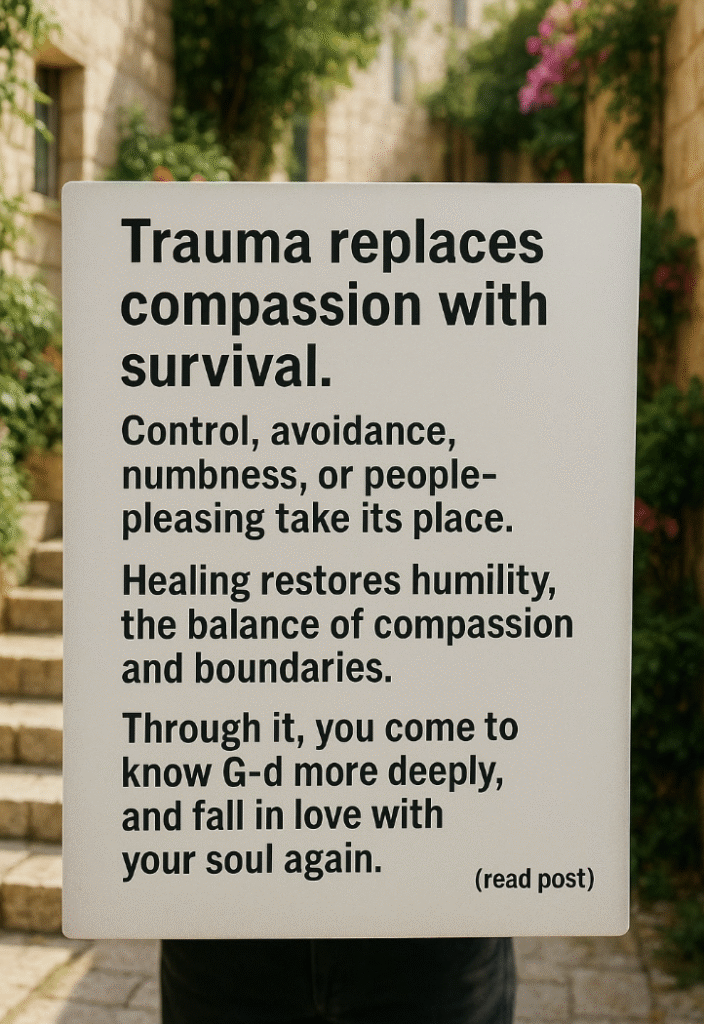
But after trauma, compassion often gets replaced.
Your system learns survival patterns that once kept you safe:
1. Fight replaces compassion with control — trying to protect through power.
2. Flight replaces compassion with avoidance — staying busy to escape feeling.
3. Freeze replaces compassion with disconnection — going numb to stay safe.
4. Fawn replaces compassion with pleasing — trading authenticity for acceptance.
These patterns are the opposites of humility. Humility is not weakness, it’s balance: the meeting point of compassion and boundaries. It’s the strength to care deeply without losing yourself.
When trauma teaches your system to choose control, avoidance, numbness, or people-pleasing,
it blocks the humility that lets compassion flow freely.
That’s a secret:
Unconditional love isn’t something you study, it’s something you live. It’s the return from survival to presence.
Through healing, you come to know G-d in a way you never could without it.Because G-d is unconditional love itself, and through every act of compassion, you begin to understand His love more deeply, and fall in love with your soul again.
The jewish secret to transform suffering into blessing, explained: https://www.facebook.com/share/p/1767s86uCd/
Checkout the comments for links to more guides to spirituality.
#spirituality#kabbalah#traumahealing