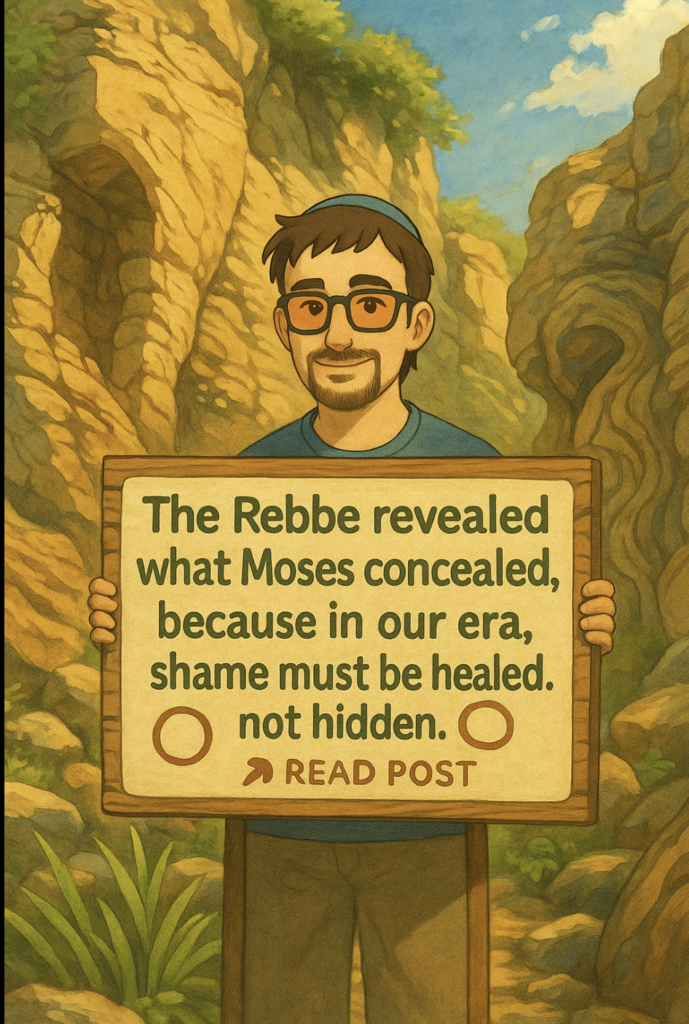
When G-d told Moses to speak to the rock instead of strike it, it wasn’t just about obedience — it was about evolution.
When the Jews first left Egypt, they were like a body coming out of trauma, still learning safety, structure, and survival.
They were at the bottom of what psychology calls the “human pyramid.”
So Moses hit the rock then, as G-d commanded, because that’s what their nervous system could understand: action, strength, stability. Forty years later, a new generation stood ready to enter the Land.
They were meant to rise higher, toward emotional maturity, curiosity, and inner work, the top of the pyramid, where safety becomes self-expression, and survival becomes relationship.
That’s why G-d told Moses to speak this time.
Words symbolize emotional connection, a nervous system calm enough to hear instead of brace. But Moses, out of deep love, chose not to reveal that contrast.
He didn’t want the earlier generation, those who had endured Egypt, to feel embarrassed that their children were more emotionally mature, meaning, more open to their emotions, while the older generation had learned strength through silence.
So he hit the rock again.
It looked like disobedience, but it was an act of tremendous compassion, so his people wouldn’t feel embarrassed.
The Lubavitcher Rebbe explained that even Moses not entering the Land of Israel wasn’t a punishment, it was love revealed.
If he had entered while they stayed behind, they would have felt abandoned and ashamed.
So he got to stay, not because he failed, but because his love refused to move on without them.
Emotional immaturity doesn’t mean someone is childish, it means life taught them to survive by suppressing what they felt. Many who grew up in harder times learned to stay calm by disconnecting, to love by working harder instead of opening up, and to prove worth by enduring pain quietly.
Emotional maturity means slowly relearning that feelings/thoughts aren’t weakness, that it’s safe to be vulnerable, that your needs/thoughts matter, and that awareness doesn’t erase strength — it deepens it.
And in my opinion, the Lubavitcher Rebbe was willing to reveal that truth in our time because he believed we’ve got to prepare for the Messianic era, when the shame of emotional immaturity must finally be transformed instead of hidden.
The earlier generation was greater in many ways, they knew G-d through suffering, felt great awe and yearning to know Him more, they did countless acts of righteousness amid immense hardship, like raising many children in a ‘broken world’, and they saw His love in survival itself.
And we, the later generations, are meant to complete their journey, by turning that endurance into emotional awareness, that faith into healing.
That’s redemption:
when the body no longer fights reality,
through fight (narcissism), flight (busyness), freeze (numbness), or fawn (people-pleasing),
when the mind no longer hides behind control,
and love can finally be revealed through awareness.
More guides:
How does trauma take away your awareness? https://www.facebook.com/share/p/19wgDRmeUB/
Why was trauma created? And the secret to transform suffering into blessing: https://www.facebook.com/share/p/17H9SPg1Pu/
why is it hard to change unhealthy beliefs? https://www.facebook.com/share/p/1BBFuSeGTh/
People pleasing is like idol worship: https://www.facebook.com/share/p/17MyBYrZJm/
We will bring the Messiah through joy – https://www.facebook.com/share/p/17Gpt4YYL5/
forgiveness doesn’t erase anger, change does: https://www.facebook.com/share/p/16NqrU1r8N/
a relationship with G-d isn’t complicated: https://www.facebook.com/share/p/1Gh2T7VHMN/
Check the comments for more guides.
#spirituality#jewish#traumahealing