

Not because nothing is happening inside you.
But because too much has been happening for too long.
Emotional numbness is often not emptiness.
Sometimes it develops because a person has carried hurt, fear, disappointment, resentment, or shame for so long that feeling everything directly becomes overwhelming.
The personality creates distance from those feelings as a form of protection.
What does baseless hatred have to do with numbness?
In Torah language, baseless hatred is not only a social problem.
At a deeper level, hatred can mean treating someone’s G-d-given purpose as though it does not matter.
Sometimes that gets directed inward.
A person may believe:
“I have to please other people to stay safe.”
“I have to avoid this.”
“It is pointless to try.”
“I have to protect myself.”
Those beliefs can gradually turn into not taking your own needs, goals, pain, or purpose seriously.
Sometimes the same pattern gets directed outward, when another person’s pain, goals, or purpose stop feeling important to you.
⸻
Prayer can become one of the tools for transforming that hidden hatred into relationship and responsibility.
But prayer only works that way when a person is not simply performing words.
A person begins with belief:
There is a Creator.
The Creator is good.
And even when I feel numb, confused, ashamed, or distant, I am still living before Him and can have a relationship with Him.
Psychologically, that can give a person an inner experience similar to being lovingly parented by something higher than the wounded parts of the personality.
Why is wanting the numbness to stop not enough?
But that belief usually does not become emotionally real simply because a person wants relief.
Wanting the numbness to stop is not enough.
Trying to force yourself to feel spiritual is not enough.
Even intense pain does not automatically create trust.
The change begins through understanding and meditation.
A person thinks deeply about what belief in the Creator actually means.
Everything exists because the Creator gives it existence.
He knows the entire story of a person’s life.
The Infinite Creator is beyond everything we can understand, yet He desires that human beings know Him, speak to Him, and come closer to Him.
A person can also begin by noticing goodness, unexpected help, patterns of wisdom, and moments of mystery.
The point is to give the mind something true to return to until belief begins affecting the emotional world.
⸻
This process did not begin with Chabad Chassidus.
Earlier Jewish thinkers explained it deeply.
Rabbeinu Bachya, for example, explained how belief in the Creator changes trust, gratitude, fear, work, dependence on other people, and the way a person understands everything they receive.
How does Chabad Chassidus explain belief as relationship?
Chabad Chassidus develops these ancient ideas in a language and structure that can be especially understandable in the modern world.
It explains belief as relationship.
It speaks about closeness and distance.
Love and awe.
Desire and attachment.
Meditation and awareness.
And how an idea can move from intellectual understanding into the emotional life of the personality.
Today we often use words like relationship and intimacy to explain this process.
Those words are not replacing traditional Jewish ideas.
They help explain what love of the Creator, awe of the Creator, attachment to the Creator, prayer, and meditation are supposed to become inside a human being.
Chabad Chassidus does not only tell a person to believe more or feel more.
It explains what to think about until a person can begin feeling:
“The Creator is here.”
“I am living before Him right now.”
“He knows the whole story.”
“I can speak with Him right now.”
“I want greater closeness with Him.”
That is one of the great contributions of Chabad Chassidus:
It gives ancient Jewish belief an especially detailed psychological structure for becoming lived relationship.
⸻
This is also why spiritual leadership matters.
Why does spiritual leadership matter for healing?
Leadership is not mainly about building the largest personal community.
Leadership means accepting responsibility to give people the ideas and guidance they need for their generation.
The Jewish people describe Moses as our great leader because the Torah he taught continues to guide us.
His leadership was not dependent only on physical presence or on everyone belonging to his personal group.
A spiritual leader gives people a way to understand reality, responsibility, and their relationship with the Creator.
The Baal Shem Tov did this.
Rabbeinu Bachya did this in an earlier era.
The Rambam did it.
The Arizal did it.
And the Chabad Rebbeim developed teachings that help explain how belief can enter the mind, reshape the personality, deepen awe, and lead toward greater love and intimacy with the Creator.
⸻
That matters especially after centuries of persecution, exile, trauma, confusion, and emotional disconnection.
Why does trust become so hard after trauma?
When people repeatedly experience danger, humiliation, loss, or instability, trust can become difficult.
A nervous system can learn:
“Do not depend on anyone.”
“Do not expect goodness.”
“Stay in control.”
“Anything can happen.”
“Protect yourself first.”
A person can consciously believe in the Creator while parts of the personality still experience reality as random, unsupported, or unsafe.
That is one reason intellectual belief alone is not always enough.
The mind may say, “There is a Creator,” while the nervous system still lives as though existence is fundamentally abandoned.
Chabad Chassidus gives a person material to meditate on until that split can slowly become smaller.
It asks a person not only:
“Do you believe in the Creator?”
But:
“What does the existence of the Creator mean for this moment?”
“What does His goodness mean for the way you understand what happened to you?”
“What does it mean that concealment is not the same thing as abandonment?”
“What would change if part of you actually felt that you are living before Him right now?”
⸻
This does not mean atheists cannot be moral, responsible, or psychologically healthy.
Rabbi Soloveitchik even discussed a value that can emerge from atheistic thinking: a person may stop waiting for Heaven to solve human problems and recognize their responsibility to act.
But a worldview can still shape the emotional assumptions a person repeatedly practices.
When someone repeatedly thinks:
“Life is random.”
“Anything can happen for no reason.”
“There is no loving structure behind existence.”
the nervous system may have less reason to expect support, meaning, or relationship.
For someone already carrying trauma, those assumptions can fit very easily into survival mode.
Not always because the person carefully reasoned their way into them.
Sometimes because emotional numbness makes relationship with the Creator feel too distant to imagine.
Jewish belief offers a different framework:
Existence has a Source.
The Source is not indifferent.
The Creator is good.
Concealment is real, but concealment is not abandonment.
And human life carries both relationship and responsibility.
⸻
The nervous system is not moved very much by abstract slogans.
How does the nervous system learn something new?
Parts of the nervous system can react almost like a very young child inside the personality.
They learn through repetition.
They notice what you repeatedly expect from reality.
If the inner message is:
“No one is coming.”
“I am alone.”
“I have to keep everyone happy.”
“I need complete control.”
“I cannot tolerate uncertainty.”
then survival patterns become easier to activate.
People-pleasing.
Avoidance.
Control.
Resentment.
Shame.
Emotional shutdown.
But the mind can also give the nervous system different evidence.
This is part of the top-down path described in Chabad Chassidus:
The mind understands something more deeply.
The person repeatedly meditates on it.
That understanding begins shaping emotional awareness.
And slowly the personality learns a different way of relating to reality.
Belief becomes more than an argument.
It becomes an environment the nervous system begins learning to live inside.
⸻
Then healthy awe can begin.
What does healthy awe actually feel like?
Awe is not simply fear.
Awe begins with awareness:
“The Infinite Creator is here.”
“I am living before the Creator right now.”
“He is near.”
“I can speak with Him right now.”
The fear within awe comes from realizing that your choices actually matter before Him.
The humility within awe comes from recognizing that your understanding is limited before Infinite Wisdom.
The wonder within awe comes from noticing that existence is filled with patterns of wisdom whose ultimate Cause is beyond anything you can fully understand.
And the relationship within awe comes from realizing:
The Infinite Creator still desires that you know Him.
That you speak to Him.
That you choose goodness before Him.
Healthy awe then awakens love.
Love says:
“If the Creator is truly here, I want to be closer.”
That love contains joy because greater closeness is possible.
That intimacy can also contain sadness because the Creator’s goodness is not yet fully revealed in you or in the world.
The person is no longer relating to spirituality mainly through performance, fear, numbness, or obligation.
They are beginning to live inside a relationship with the Source of life.
⸻
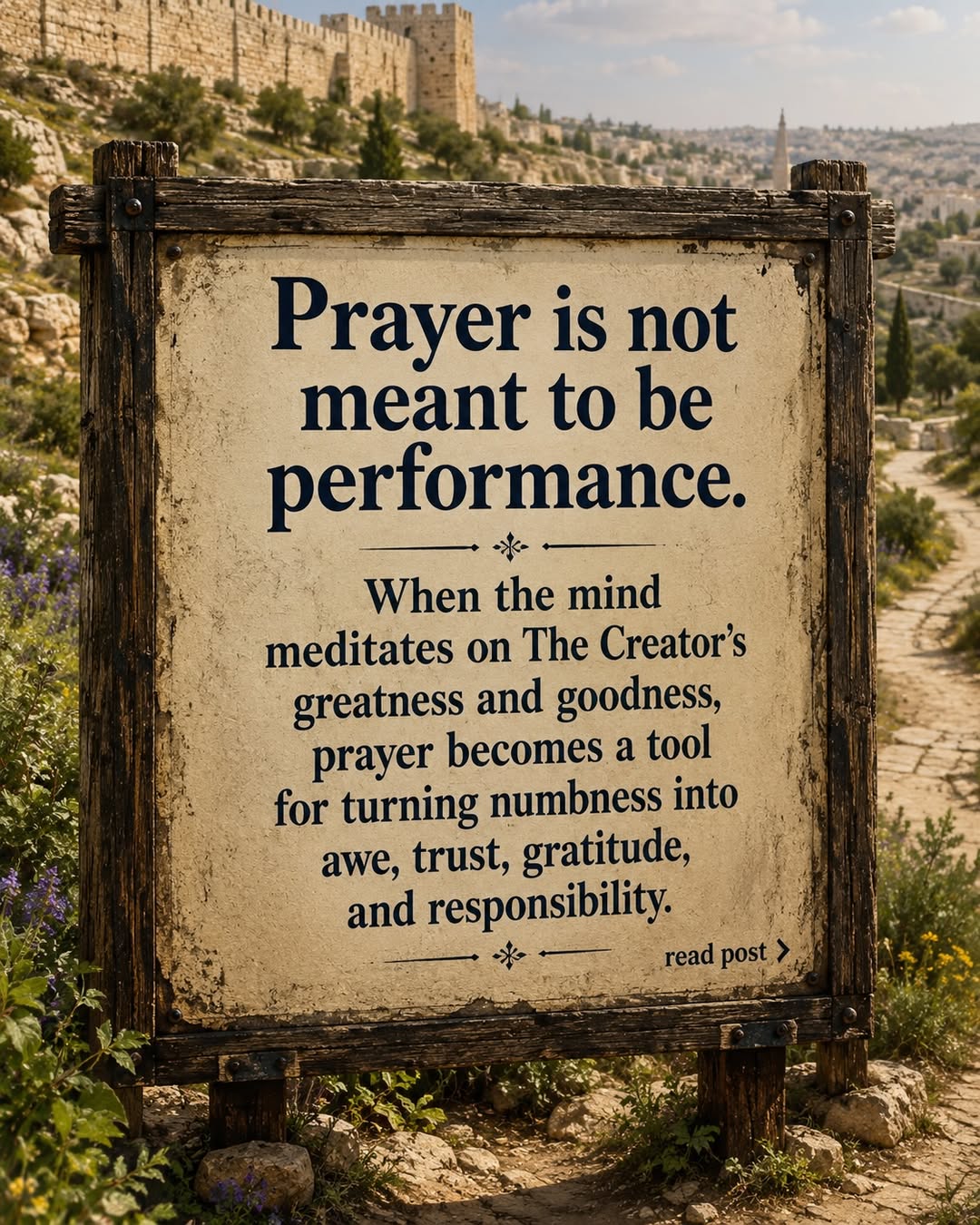
That is when prayer becomes powerful.
When does prayer become repair?
Prayer is not just saying spiritual words.
It is a place where the person brings the real personality into relationship with the Creator.
The person brings their anger, resentment, shame, fear, numbness, confusion, longing, and desire for justice into the relationship with the Creator.
And then the person keeps returning to awareness:
“You are here.”
“I am before You.”
“I can speak with You.”
“I want to understand.”
“I want to become closer.”
Hidden hatred can become honesty.
Honesty can open into awe.
Awe can deepen trust.
Trust can create gratitude.
Gratitude can awaken responsibility.
And responsibility can become relationship.
Without that inner movement, prayer can remain performance.
With it, prayer can become repair.
The Baal Shem Tov taught that it is almost miraculous that a person can remain alive after genuine prayer.
When a person truly reaches the awareness:
“When I am with You, I desire nothing else on earth,”
the longing for closeness can become overwhelming.
⸻⸻⸻⸻
More guides:
Chabad leadership does not mean every Jewish person should copy Chabad culture, send their children to Chabad schools, or agree with every interpretation held by individual Lubavitch Chassidim.
It means the Chabad Rebbeim revealed and developed teachings that help this generation understand how belief can become emotionally real, deepen awe, transform unhealthy assumptions, and bring a person into greater relationship with the Creator.
A person also cannot measure another person’s awe and love simply by how religious they look.
The Sixth Chabad Rebbe emphasized that external appearance does not reveal the full inner spiritual state of a person.
And the Lubavitcher Rebbe repeatedly presented his own teachings as a continuation and explanation of the teachings of the Sixth Rebbe.
The larger question is not:
“Whose community is biggest?”
It is:
“What teachings help a generation return to a deeper awareness of the Creator, develop healthier awe and love, and live with greater relationship and responsibility?”
The Messiah will be a leader that is beloved by everyone.
How to understand curses in the Hebrew Bible.
How does free choice work?
Why was suffering built into creation?
Explore the NextSelf Blog. Start with this post explaining the world of souls, and what does it mean to be light? And my Youtube. Content is published to this facebook first and a few days later, to the blog.
The blog lists all the difference patterns to study, understanding patterns is how one can develop 'Daas' [felt knowing].
Content does not provide medical services or professional counseling, and it is not a substitute for professional medical care.