

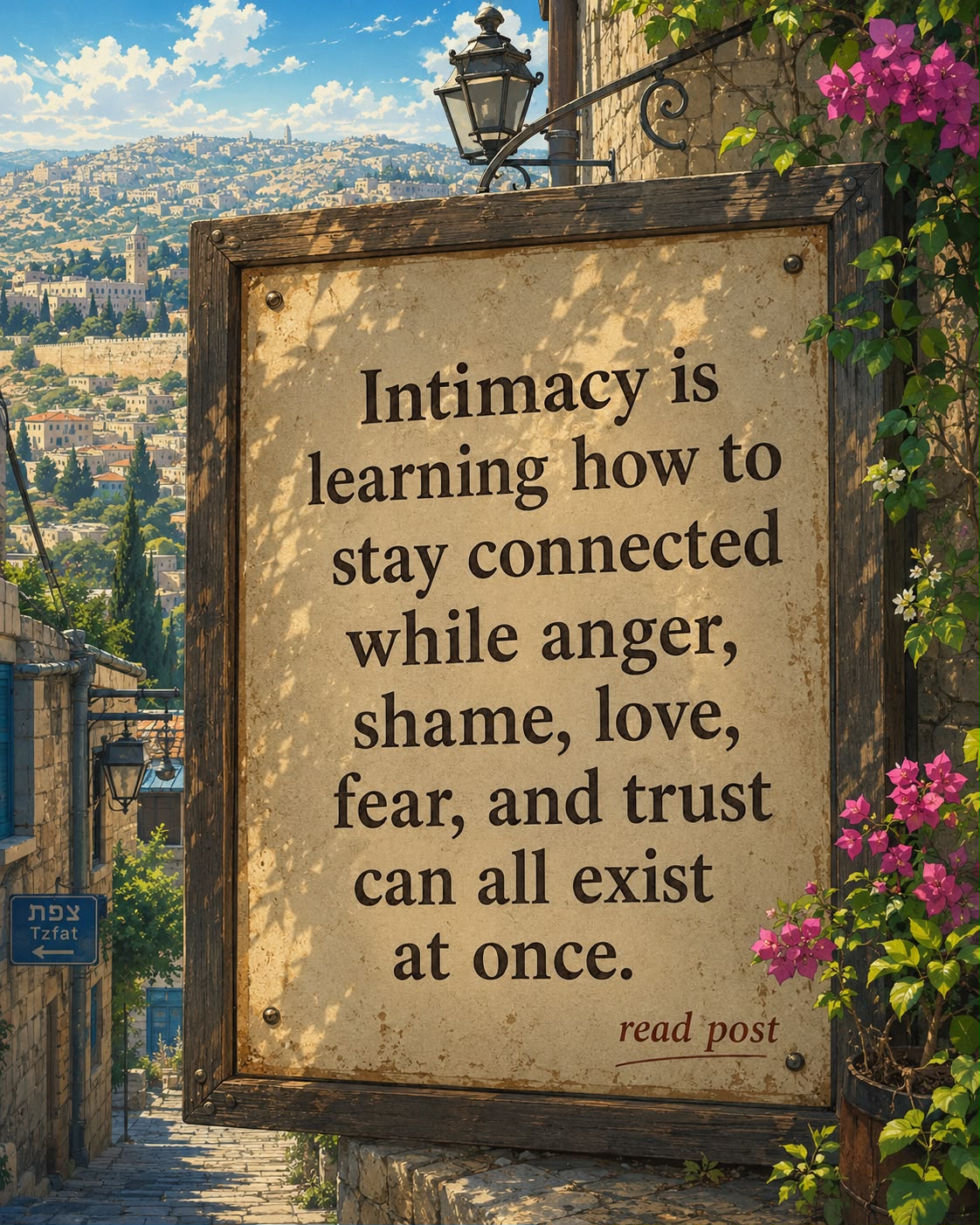
Intimacy requires being able to hold complex feelings.
You can love someone and still feel angry at them.
You can trust someone in some ways and still need boundaries in other ways.
You can feel ashamed of something you did without deciding that you are a terrible person.
You can feel disappointed in someone and still care about them.
You can feel angry at G-d [The Creator] and still want to be close to Him.
Adaptive trauma patterns can make this much harder.
______________________
Fight may try to push painful feelings outward through anger, blame, criticism, or control.
Flight may try to escape the feelings by staying busy, avoiding the conversation, or distracting yourself.
Freeze may try to shut the feelings down so you do not have to feel how painful or confusing they are.
Fawn may try to protect the relationship by pleasing the other person, giving up boundaries, or quickly trying to make them happy again.
These patterns develop because the nervous system is trying to protect you from feelings that once felt too hard to handle.
But healthy intimacy requires learning a different set of emotional skills.
Awareness helps you notice several feelings at once instead of letting one pattern take over.
Compassion helps you feel something painful without attacking yourself for feeling it.
Boundaries help you stay connected to someone without giving up what you need.
Humility helps you accept that two things can be true at the same time.
“I love you, and I am angry at you.”
“I care about you, and I need distance.”
“I did something wrong, and I am still a person who can grow.”
______________________________
This matters in relationships with people.
It also matters in a relationship with the Creator.
A person may need to learn how to say:
“I am angry at You, and I still want to be close to You.”
“I don’t understand why this happened, and I know there are things I do not understand.”
“I am having a hard time trusting You, and I still want to learn how to trust You.”
This is very different from forcing yourself to feel only the feelings you think you are supposed to have.
Trust can grow as you become curious about the darkness you have experienced.
You begin noticing patterns.
What did this suffering show me about my fears?
What emotional skills did I need but not yet have?
What can I learn from what happened?
How can this experience help me develop more awareness, compassion, boundaries, humility, or trust?
Finding meaning does not mean pretending the suffering was good.
It means developing the inner strength to take something that created fear, shame, anger, or distance and slowly transform it into greater intimacy.
The darkness itself can become part of what teaches you how to have a deeper relationship with yourself, with other people, and with the Creator.
Intimacy does not mean always having one clear feeling.
It means learning how to stay connected while different feelings are happening inside you, and developing enough trust and inner strength to transform the darkness instead of only trying to escape it.
Emotionally healthy beliefs about the world of souls: https://www.facebook.com/share/p/1CyKapyFo3/
Why is suffering apart of creation? https://www.facebook.com/share/p/1DWd2J9hyY/
Emotional numbness stops awe from being felt: https://www.facebook.com/share/p/1EQTrsibeH/
Why are the Jewish people a great source of blessing? https://www.facebook.com/share/p/1ET8pRvpsL/
Why is jesus embarrassed about the Catholic Church? https://www.facebook.com/share/p/1FJdBopvQr/
Every worldview has mystery, some mysteries are more reasonable: https://www.facebook.com/share/p/1ERd7gzfQe/
Explore the NextSelf 2026 Index and 2025 Index. Start with this post explaining the world of souls.
They organize the core ideas on awareness, compassion, boundaries, and how they build real relationship and responsibility with The Creator.
Update: When an individual trusts the Creator is good, awe [wonder, humility and fear], which is felt after noticing patterns of infinite wisdom, causes love to be felt and that love includes sadness because His goodness can always be more revealed and joy.
All information is for educational purposes only.