

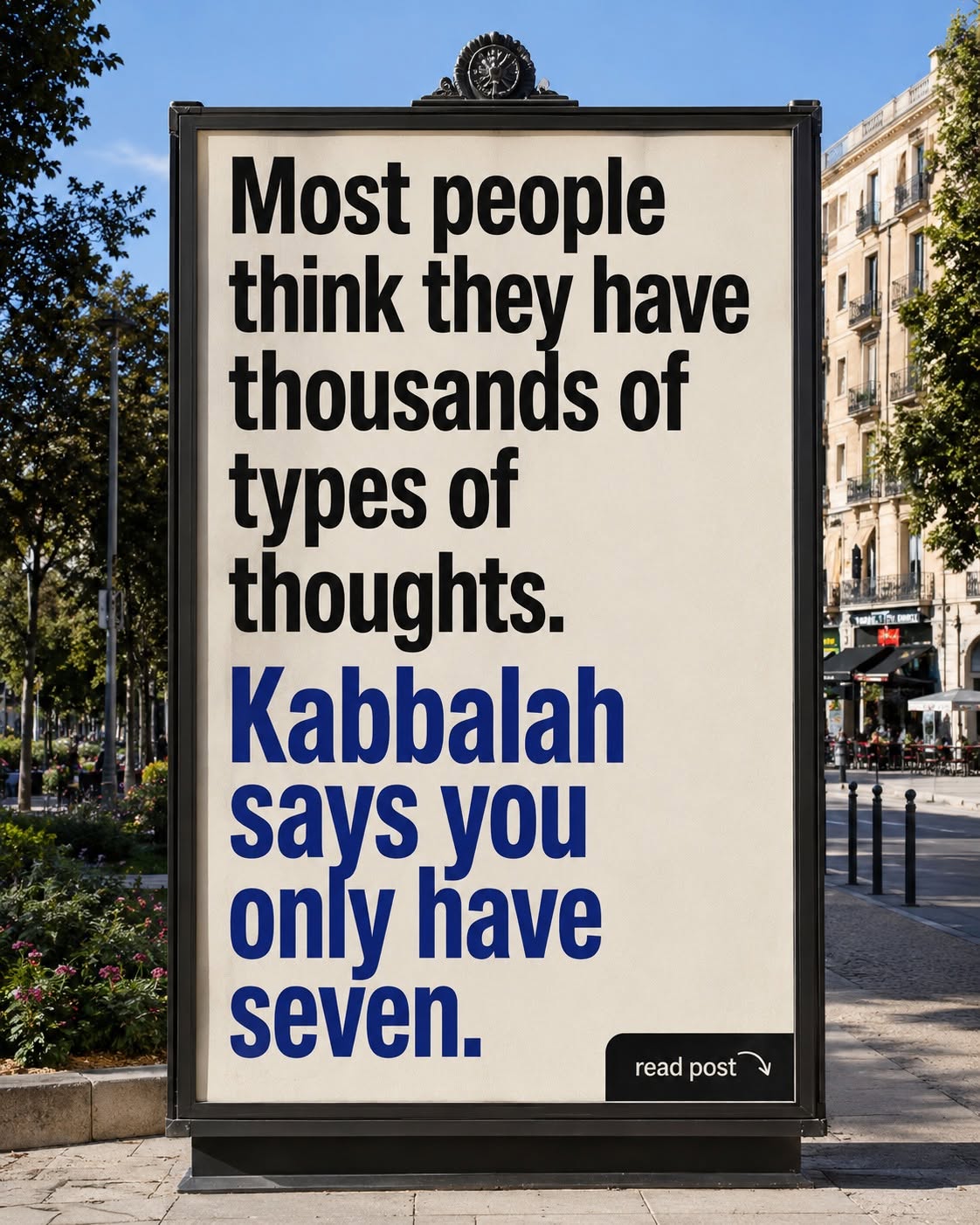
What does it mean that we only have seven types of thoughts?
Every thought comes from one of seven emotional qualities.
Kabbalah teaches that each quality can be expressed in a healthy way or a misguided way.
A misguided expression is called a fallen spark.
_______________
Why do healthy qualities become misguided?
Misguided thinking is possible because the Creator conceals His giving, which lets a person feel independent.
Survival-mode thinking is one result of that hiddenness: the mind starts asking, “How do I protect myself?” instead of, “How do I reveal goodness?”
Beauty can become vanity, showing off.
Love can become people-pleasing, avoiding rejection.
________________
How is the mind a bridge between G-dliness and emotion?
Chabad Chassidus explains that the mind is the bridge between G-dliness and the emotions.
By G-dliness, I mean the Creator’s goodness being revealed in the world.
When wisdom becomes calculation instead of curiosity, it stops channeling G-dliness into revealed goodness.
The emotional qualities then become easier to misguide.
When wisdom is connected to G-dliness, curiosity, and truth, the emotional qualities become easier to lift back up.
Why does repairing Chabad repair the other sparks?
That is why fallen Chabad sparks affect the other sparks.
Chabad means wisdom, understanding, and knowledge.
And repairing Chabad helps repair the rest.
Getting better at awareness, self-compassion, compassion, boundaries and self-forgiveness is how you repair fallen energy.
________________
What do Chessed, Gevurah and Tiferes feel like?
Rabbi Paltiel has classes that explain the Sefirot like below:
Chessed- you react to what you see – feeling a situation.
Gevurah – feeling the people – react to the people involved in what you see.
Tiferes- feeling what the people feel – if you feel what the person feels, they can be bad and you have mercy.
Tiferes is without judgement – There is a place where we are all one.
Gevurah feels the person and may say “don’t help.”
Gevura shebitiferes is deeper then chessed shebitiferes Because You appreciate the limitations of how you can help.
I feel the person and the right thing is too help – chessed bitiferes.
I feel the person and I won’t help or put in specific amount of effort when helping like getting him exactly what is helpful like a sandwich – gevurah shebitiferes.
Feeling happy for someone comes from tiferes.
A Primary mida of tiferes is being happy for someone.
________________
Related guides:
Rabbi YY Jacobson gave a lengthy recorded class on the Chernobyl Maggid teaching.
How does Chassidus, teachings through the Baal Shem Tov, explain the Creator? The word G-d is a descriptive name
The 13 principles of faith by Maimonides have to be understood through Chabad Chassidus to be healing for the nervous system: Beliefs are not only an idea in your mind
Questions people ask
How many types of thoughts do we really have?
The Chernobyl Maggid, a student of the Baal Shem Tov, teaches that there are only seven. Every thought comes from one of seven emotional qualities, and each of those qualities can be expressed in a healthy way or a misguided way. Most people assume they have thousands of different kinds of thoughts.
What is a fallen spark in Kabbalah?
A fallen spark is the misguided expression of one of the seven emotional qualities. Beauty can become vanity and showing off. Love can become people-pleasing and avoiding rejection. This is possible because the Creator conceals His giving, which lets a person feel independent.
How do you repair a fallen spark?
By repairing Chabad, which means wisdom, understanding and knowledge. When wisdom is connected to G-dliness, curiosity and truth, the emotional qualities become easier to lift back up. Getting better at awareness, self-compassion, compassion, boundaries and self-forgiveness is how you repair fallen energy.
Where does feeling happy for someone else come from?
Feeling happy for someone comes from Tiferes. A primary mida of Tiferes is being happy for someone. Tiferes is feeling what the other person feels, and it is without judgement, because there is a place where we are all one. Mercy comes from that same feeling, even when the person is behaving badly.
“Most people think they have thousands of types of thoughts. Kabbalah says you only have seven.”
Explore the NextSelf Blog. Start with this post explaining the world of souls. And my Youtube. Content is published to this facebook first and a few days later, to the blog.
The blog lists all the difference patterns to study, understanding patterns is how one can develop 'Daas' [felt knowing].
Update: As awe, trust, and love deepen, they can allow greater openness and intimacy with the Creator. That intimacy can include sadness when you notice how much more of His goodness can be revealed.