Not basic goodness.
Goodness that can be recognized, chosen, received, and held without shame.
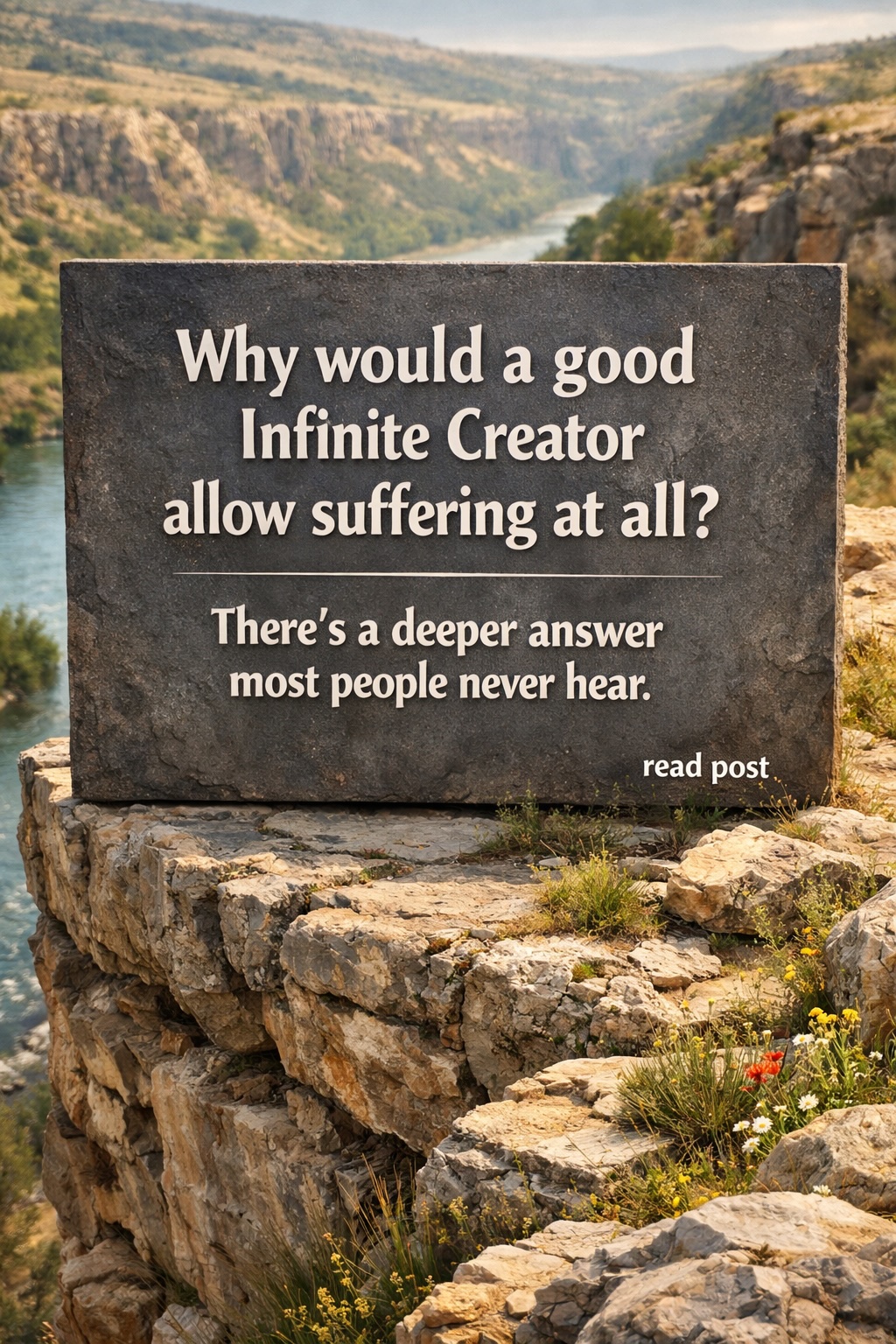
But to understand suffering, we first have to understand what we mean by The Creator.
The Infinite Creator is not a bigger being inside the universe.
He is not an object, not a body, not a force trapped inside nature, not a bigger version of a person, and not something contained inside the universe.
He is the source of existence itself.
Everything exists because existence is being given by Him at every moment.
As the Rambam explains, if everything that exists were dependent on something else for existence, nothing would ever exist.
So suffering does not happen in a world abandoned by Him.
It happens inside a creation continuously held in existence by Him, but built in a way that allows for freedom, growth, distance, and repair.
Human beings cannot receive goodness with the same dignity when it feels completely unearned.
It would feel embarrassing.
Based on a teaching of the Lubavitcher Rebbe, The Creator did not only give goodness.
He built a world where goodness can be discovered, revealed, chosen, and received with dignity.
A world that only received goodness passively would be easier, but it would not reveal the same dignity, partnership, responsibility, or depth of connection.
So creation was built not only to receive goodness, but to become able to recognize it, choose it, and hold it without shame.
Chassidus describes the beginning of creation through the language of light and vessels.
Not physical light.
In simple terms, light means the goodness The Creator wants to reveal, and vessels means the inner capacity to receive it.
Light is The Creator’s desire for His goodness to be felt and known.
As Rabbi YY Jacobson explains, light is a metaphor for The Creator’s desire to be perceived.
Vessels are the spiritual capacities meant to hold that goodness: wisdom, understanding, kindness, strength, beauty, and the rest.
The design was that there was more light available than the vessels could hold at first.
This was not a mistake.
It was a setup for dignity.
Because if the vessels only received what they could already hold, life would be pleasant, but basic.
There would be no real growth, no real partnership, and no earned goodness.
So The Creator made it this way:
Extra goodness exists, and the vessels have to develop to receive it.
That development requires emotional skills.
It is relationship work.
When emotional skills are practiced, more goodness can be revealed safely, without collapsing into people-pleasing, avoidance, arrogance, control, shame, or numbness.
But when a vessel cannot yet hold the light available to it, that vessel experiences distance.
That distance is felt as suffering.
Psychology and Chassidus are not explaining reality from the same layer.
Psychology often explains fear, shame, and survival responses as protective functions inside the nervous system.
That is useful.
Fear helps a body notice danger.
Shame can help a social being notice disconnection.
But Chassidus goes deeper.
Chassidus asks why a person experiences themselves as a separate being that has to protect itself in the first place.
That experience of separateness is ego.
So psychology can describe how survival responses function inside the body.
Chassidus explains the deeper spiritual root: the felt distance from the Source of existence.
From the Chassidic view, ego feelings are feelings that make a person experience themselves as separate, self-protective, and alone.
Fear.
Shame.
Guilt.
Insecurity.
The inner sense of “I am on my own.”
Ego feelings create disunity.
Instead of the vessels working together as one system, each part begins protecting itself.
They compete, tighten, and stop cooperating.
That disunity leads to shattering.
Too much light, combined with a system acting separately, creates breakdown.
This stage of creation is called Tohu.
A world with a lot of light, but not enough ability to hold it together.
Shattering does not mean the light is bad.
It means goodness met a system that could not cooperate yet.
Then the shattered pieces of the vessels became the raw material of our physical world.
In Chassidus, this is described as fallen sparks.
Meaning:
Our world is built from mixed pieces, sparks of goodness hidden inside broken patterns.
The goodness is still there, but it is mixed with fear, shame, distortion, and self-protection.
And those broken patterns are not only out there.
They are also inside us.
That brokenness entered the human story very early.
The snake introduced a way of relating built on distortion, fear, and separation.
Adam and Eve absorbed that way of relating.
They stopped believing they could live honestly before The Creator and still be loved.
So they hid.
Chassidus explains this as a spiritual story about concealment, distance, and relationship.
Psychology describes some of the same human experience through the language of the nervous system, attachment, trauma, and survival responses.
Survival mode is not random.
Biologically, it runs deep in the body because the nervous system is built to protect life.
Spiritually, it expresses the deeper experience of distance, hiddenness, and separateness.
Fight says, “I have to protect myself.”
Flight says, “I have to escape.”
Freeze says, “It is pointless to try.”
Fawn says, “I have to please others to stay safe.”
Control says, “I have to control everything or I will not be safe.”
Perfectionism says, “I measure my value by how I compare to others.”
Numbing says, “I do not feel, and I do not even have words for it.”
Not because we are evil.
Because the system learned:
“This is how I survive distance.”
“This is how I survive feeling alone.”
But felt distance is not only the cause of survival mode.
It is also the raw material of awe.
If distance is held without enough emotional steadiness, it turns into shame, fear, control, avoidance, and numbness.
But if that same distance is reframed with truth, with the understanding that the distance hurts because relationship is real, it becomes awe.
And awe is where a relationship with The Creator begins.
Awe weakens hatred because hatred grows when pain stays trapped inside ego.
Awe does not erase loneliness.
It gives loneliness direction.
What felt like abandonment starts to feel like longing for relationship.
Awe is not only wonder.
It is wonder, fear, and sadness together.
Wonder at His greatness.
Fear because your choices matter.
Sadness because His goodness can always be more revealed.
Awe grows through appreciation.
When you notice what you have and express appreciation for it, your sense of wonder increases.
You start to feel:
“I am being given something.”
That deepens awe.
Because awe is not only about how great The Creator is.
It is also about noticing His goodness in your actual life.
And that makes the distance feel real, not as abandonment, but as longing for relationship.
So what is healing?
Healing is not only learning to feel better.
It is learning how to let felt distance become awe instead of survival mode.
It is repair in the body and mind.
It is learning how to carry fear, sadness, shame, and guilt without letting them run the whole system.
It is building bigger vessels.
Psychologically, healing does not mean eliminating fear, shame, or protective responses.
It means learning how to hold them without becoming dominated by them.
In IFS language, this means learning to unblend from reactive parts of the personality, so fear, shame, avoidance, and control are no longer treated as the whole self.
They are younger protective parts that need compassion, guidance, and reparenting.
In Chassidus, this means the person becomes less trapped inside ego and more able to live in relationship with The Creator.
That is the movement from survival mode toward relationship mode.
A person begins to live with more honesty, appreciation, compassion, boundaries, and responsibility.
Shame becomes self-compassion.
Fear becomes trust.
Control and threats become compassionate boundaries.
Blaming becomes owning.
Numbness becomes the practice of feeling.
Isolation becomes the practice of connection.
This requires all of us to grow in awareness, compassion, boundaries, and self-forgiveness.
Based on a teaching of the Chernobyl Maggid, a student of the Baal Shem Tov, every thought comes from one of the emotional qualities.
Rabbi YY Jacobson has a class explaining this teaching.
There is even a hidden gift in being misguided.
When a person wakes up, they often feel a deep motivation to help others who fell into the same place.
As vessels develop, and as people grow in humility, compassion, boundaries, and self-forgiveness, more goodness can be revealed safely.
Goodness that once overwhelmed us starts to feel like calm, love, and clarity.
And this does not only happen inside one person.
It happens across generations.
A lot of survival mode is inherited, learned in families, stored in bodies, and passed down as behavior patterns.
The era of revealed goodness, the world to come, is a time when goodness will not only exist, but be openly felt.
It is when humanity heals enough from that original human experience of distance.
When human beings stop experiencing His hiddenness only as abandonment, and become more able to experience it as a place for relationship, we become capable of connecting with the very light that once felt like darkness.
Not because the light changed.
Because the vessels, meaning us, became steadier, more connected, and more united.
That is why repairing relationships is the main work.
Not only between individuals, but also between communities and nations.
This is also why the Lubavitcher Rebbe is a leader for our generation.
The Jewish people always described Moses as a leader because his Five Books guide us, not because of his physical presence alone, or because everyone was part of his personal tribe.
Chabad Chassidus has been explaining the deepest ideas about The Creator’s goodness for over 200 years.
The Rebbe took that depth and made it accessible, structured, and alive for this generation.
He did not leave those ideas vague.
He published over 70,000 pages of original teachings, clear, structured, and deep, so they could be studied, revisited, and applied across generations.
The Rebbe also began explaining in 1951 why the leader of a generation can be someone who passed away and is not physically alive, and his teachings support that worldview.
And his influence is not fading.
It is increasing every year.
A leader of the generation cares for every person and reveals ideas that help people understand The Creator’s goodness more truthfully.
That is why his teachings still matter.
Based on a talk of the Lubavitcher Rebbe on a Midrash, one way to understand human repair is this:
When one person does real relationship work with another human being, it is like bringing an atonement offering on behalf of The Creator for the suffering built into creation.
Not because The Creator gives each person a personal apology.
But because repair happens through human beings becoming more responsible, compassionate, and honest with each other.
Meaning:
The Creator made room for a world that could feel painful, so that human beings could turn pain into partnership through awareness, compassion, boundaries, self-forgiveness, and appreciation.
Underneath all of this is an even deeper point:
Creation is not random.
It is intentional.
It has a structure built into life itself.
Creation is not only made of matter and objects.
It is also made of processes inside life: pleasure, desire, emotion, understanding, and choice.
Pleasure is the basic goodness of existence.
Desire is life reaching toward that goodness.
Emotion is what that reaching feels like from the inside.
But because created beings have free choice, ego feelings can interfere with that reaching.
Fear, shame, guilt, and insecurity can block desire from receiving what is good.
And because human beings were created in His image, we do not only react.
We can also understand.
As Rambam explains, being created in His image does not mean having a body like Him.
It means having intelligence, the capacity to recognize truth.
So the human being was made with two great capacities:
To understand.
And to choose.
That means creation was built for more than existence.
It was built for conscious relationship, where goodness is noticed, chosen, appreciated, and shared.
So the goal is not only that goodness exists.
It is that goodness be recognized, chosen, shared, and received without shame.
That is why creation is desired:
So divine goodness could be revealed through relationship, until even this lowest world becomes a place of real intimacy with The Creator.
People-pleasing, abuse, and avoidance may all come from the same place:
A person who never learned how to handle feeling alone.
This framework organizes the core ideas of awareness, compassion, boundaries, and self-forgiveness into one goal:
Building real relationship and responsibility with The Creator.
 Visit the blog for more spiritual and psychology education.
Related guides:
Psychology of healthy prayer explained.
How are jewish beliefs psychologically more healthy then all other belief structures?