

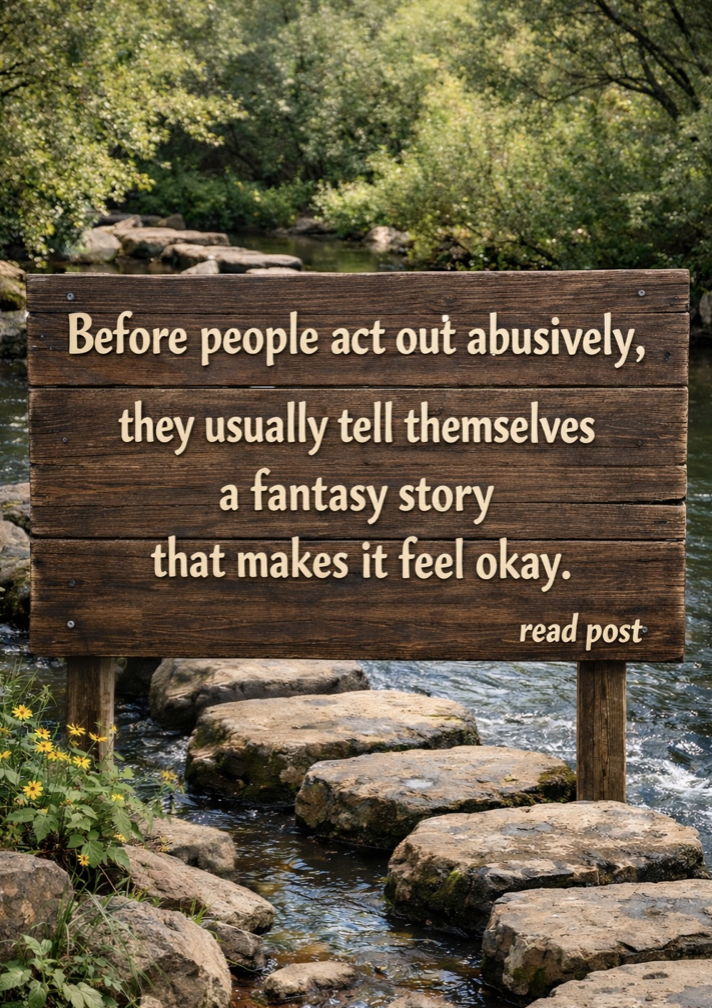
First, they give themselves permission.
That permission usually does not appear in one moment. It builds over time through the thoughts someone repeats to themselves.
What does that permission sound like?
Sometimes the permission sounds like this:
“She’s just trying to control me.”
“She’s making something out of nothing.”
“She ignores all the good I do.”
“I already work hard enough.”
“I was just angry.”
“There’s only so much a person can take.”
“They wanted it.”
“They’re mature for their age.”
“No one will get hurt.”
“No one needs to know.”
Each thought can feel small. Even ‘fair.’
But together, they build a story where holding back feels wrong and acting out feels okay. That is why “I lost control” is usually not the full truth.
Do strong feelings really erase choice?
People still choose what they say, who they aim it at, how far they go, and when they stop.
Strong feelings do not erase choice.
They just make the story louder. Before someone acts abusively, they usually tell themselves a fantasy story that makes it feel justified.
What does the fantasy story do for them?
Sometimes that story protects their ego.
Sometimes it helps them avoid shame/apologizing.
Sometimes it simply gives them a quick release of anger.
Because letting aggression out can feel powerful for a moment. It brings fast relief. It can feel easier
than sitting with the feeling inside. For some people, control and power themselves start to feel rewarding.
Dominating the moment, silencing the other person, or forcing the situation their way can numb the nervous system and release tension.
Over time, that feeling can become addictive.
Why is honest anger the harder road?
Processing anger honestly takes more effort,
more responsibility,
and more self-control.
It also requires practicing skills that don’t always feel comfortable, like compassion and sitting with difficult emotions such as guilt, fear, and shame.
So sometimes the person is not only avoiding shame.
They are also choosing the faster release over the slower work.
Do mental health struggles remove choice?
Mental health struggles are real.
They can make emotions stronger.
They can make life harder.
They can make it harder to slow down.
But in most cases, they do not erase choice.
Usually only a very severe mental break from reality makes a person truly unable to know what is real or govern their actions. That means things like hearing voices, seeing things that are not there, or believing harmless people are trying to kill you.
Most people are not in that state. So pain may be real. Trauma may be real. Struggle may be real. But abusive actions are still actions. And actions are still choices. Understanding this matters.
Why does believing the story keep abuse going?
Because abuse often continues when people around it keep believing the story:
“He just lost control.”
“She didn’t mean it.”
“They couldn’t help it.”
But the truth is usually simpler. Someone told themselves a story that made harming someone feel okay. And recognizing that truth is often the first step to refusing to accept it anymore.
Questions people ask
Does “I lost control” explain abusive behavior?
Usually not. People still choose what they say, who they aim it at, how far they go, and when they stop. Strong feelings do not erase choice. They just make the story louder, so “I lost control” is usually not the full truth about what happened.
Can controlling or dominating someone become addictive?
Yes. For some people, control and power themselves start to feel rewarding. Letting aggression out can feel powerful for a moment, and it brings fast relief. Dominating the moment, silencing the other person, or forcing the situation their way can numb the nervous system and release tension. Over time, that feeling can become addictive.
When is someone truly unable to control their actions?
Usually only a very severe mental break from reality takes that away, leaving a person unable to know what is real or govern their actions. That means things like hearing voices, seeing things that are not there, or believing harmless people are trying to kill you. Most people are not in that state.
What does it take to handle anger without harming someone?
More effort, more responsibility, and more self-control. It also means practicing skills that do not always feel comfortable, like compassion and sitting with hard feelings such as guilt, fear, and shame. That slower work takes longer than a fast release of aggression, which is why some people choose the quicker way instead.
“Before people act out abusively, they usually tell themselves a fantasy story that makes it feel okay.”
Explore the NextSelf Blog. Start with this post explaining the world of souls. And my Youtube.
The blog lists all the difference patterns to study, understanding patterns is how one can develop 'Daas' [felt knowing].
Update: As awe, trust, and love deepen, they can allow greater openness and intimacy with the Creator. That intimacy can include sadness when you notice how much more of His goodness can be revealed.