

Most people already know that your beliefs affect your confidence.
They affect how safe you feel.
They affect how much you trust people.
They affect whether you open up, repair, apologize, forgive, or stay defended.
That is not religion.
That is psychology.
How does psychology explain what beliefs do?
Psychology is a science, and psychology, especially generational trauma research, can explain how beliefs shape the nervous system.
A person who believes reality is random is not only holding an idea.
He is training his nervous system to live in a world where nothing is guiding life.
Pain has nowhere deeper to go.
Responsibility feels heavier.
Vulnerability feels more dangerous.
Self-worth has to be built from mood, success, approval, intelligence, appearance, comparison, or control.
That is where low self-esteem loops grow.
What does a random world sound like inside the mind?
The mind starts saying:
Nothing is guiding life.
Nobody is guiding reality.
My pain does not matter.
My choices do not matter that much.
I have to protect myself because reality is not trustworthy.
Those thoughts do not stay as thoughts.
They become a felt reality in the body.
They make a person more defended, more alone, and more trapped inside his own mind.
What changes when you believe the Creator is good?
Belief in an Infinite Creator who is good does the opposite.
It teaches the nervous system that reality is not random.
Pain is not meaningless.
Responsibility is not pointless.
Goodness is not pretend.
Vulnerability is not foolish.
That does not mean life is easy.
It does not mean suffering disappears.
It means a person has a deeper place to stand while suffering.
What happens when the nervous system learns trust?
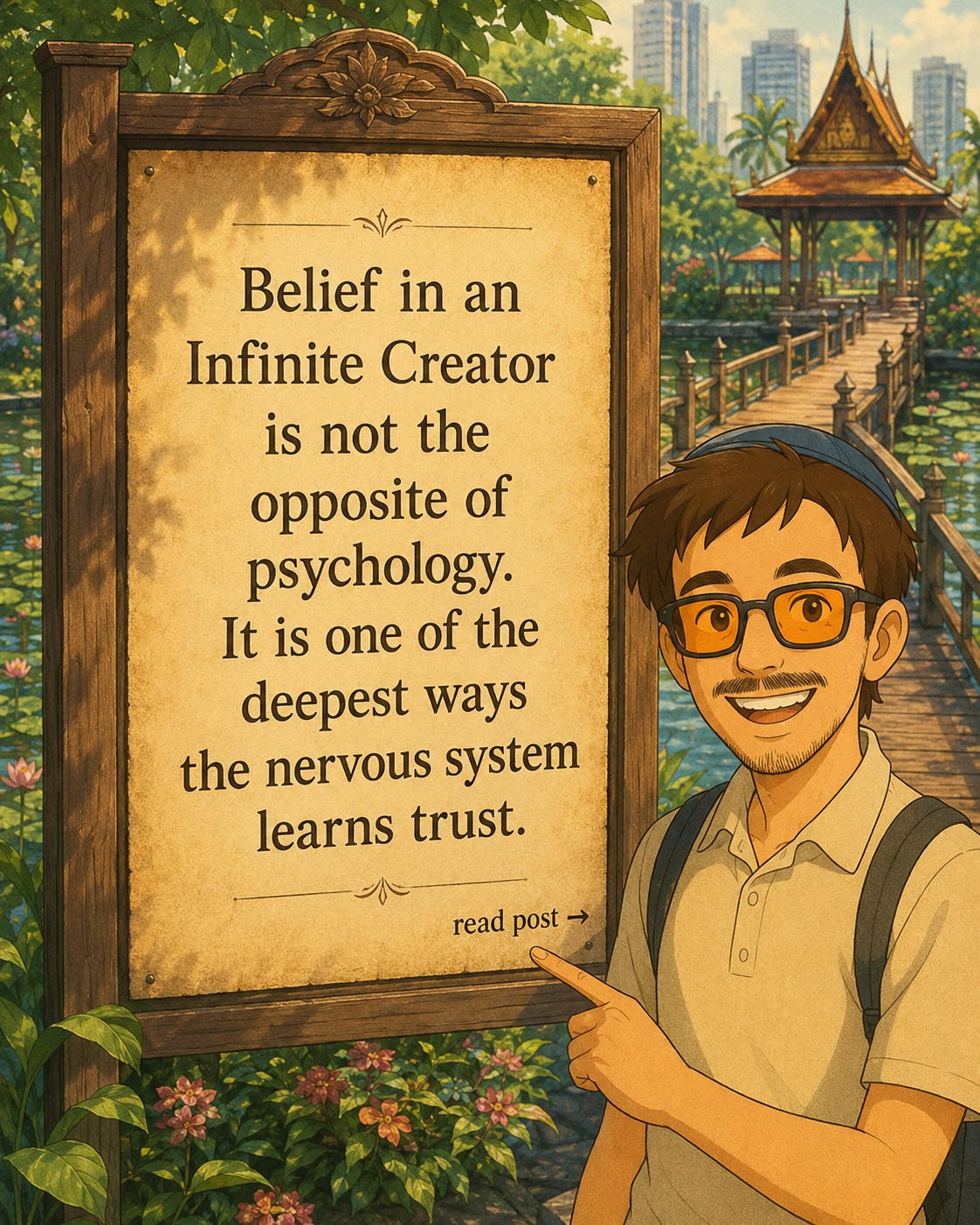
That is why belief in The Creator is not the opposite of psychology.
It is one of the deepest ways the nervous system learns trust.
And when the nervous system learns trust, emotional maturity becomes easier.
Honesty becomes easier.
Repair becomes easier.
Closeness becomes easier.
The nervous system influences how an individual acts.
A person becomes more emotionally available without becoming weaker, because his nervous system is no longer being trained by the belief that life is random, nobody is guiding reality, and closeness is unsafe.
Does the nervous system have a personality?
Trauma research shows that the nervous system is not just a machine under the mind.
It has patterns.
It has reactions, it has a personality like a 2-4 year old.
Unhealthy beliefs from Atheism, Christianity, Islam and Buddhism trigger the nervous system, in an unhealthy way (those beliefs also contain spiritual gifts like how to feel deeper and love or accept more responsbility.
Why are the 13 principles of faith emotionally healthy?
The 13 principles of faith as explained by the Rambam, Maimonides, are emotionally healthy for the nervous system.
They teach there will be a world to come era where resurrection of the dead begins for all nations, some will live with lots of shame, others with deeper joy, depends on how you live now, no need to live in fear of rejection or randomness.
Some people will resurrect decades or more before others, depends on how righteously or selfishly an individual acts, some will spend decades or longer making reparations in that future era.
How does a relationship with the Creator begin?
Relationship with the Creator begins with awe, which is a blend of humility, fear and wonder, if one isn't feeling 1 of those, a relationship isn't happening, your reality might be an opinion about Him.
The belief means always feeling wonder.
If you trust He is good, awe causes love to be felt.
Questions people ask
How do your beliefs affect your confidence?
Beliefs do not only sit in your mind. They affect how safe you feel, how much you trust people, and whether you open up, repair, apologize, forgive, or stay defended. That is not religion. That is psychology, because generational trauma research can explain how a belief slowly shapes the nervous system.
Why does believing that life is random lower self-esteem?
When a person believes reality is random, pain has nowhere deeper to go, responsibility feels heavier, and vulnerability feels more dangerous. Self-worth then has to be built from mood, success, approval, intelligence, appearance, comparison, or control. That is where low self-esteem loops grow, and the thoughts become a felt reality in the body.
Is faith the opposite of psychology?
No. Belief in an Infinite Creator who is good teaches the nervous system that reality is not random, that pain is not meaningless, and that vulnerability is not foolish. It does not mean suffering disappears. It means a person has a deeper place to stand while suffering, and it is one of the deepest ways the nervous system learns trust.
Which emotional skills get easier when the nervous system trusts?
Emotional maturity becomes easier, and so do the emotional skills that live inside it: honesty, repair after a rupture, and closeness without becoming weaker. Awe is practiced too, a blend of humility, fear, and wonder, and when a person trusts He is good, awe causes love to be felt.
Explore the NextSelf Blog. Start with this post explaining the world of souls. And my Youtube.
The blog lists all the difference patterns to study, understanding patterns is how one can develop 'Daas' [felt knowing].
Update: As awe, trust, and love deepen, they can allow greater openness and intimacy with the Creator. That intimacy can include sadness when you notice how much more of His goodness can be revealed.