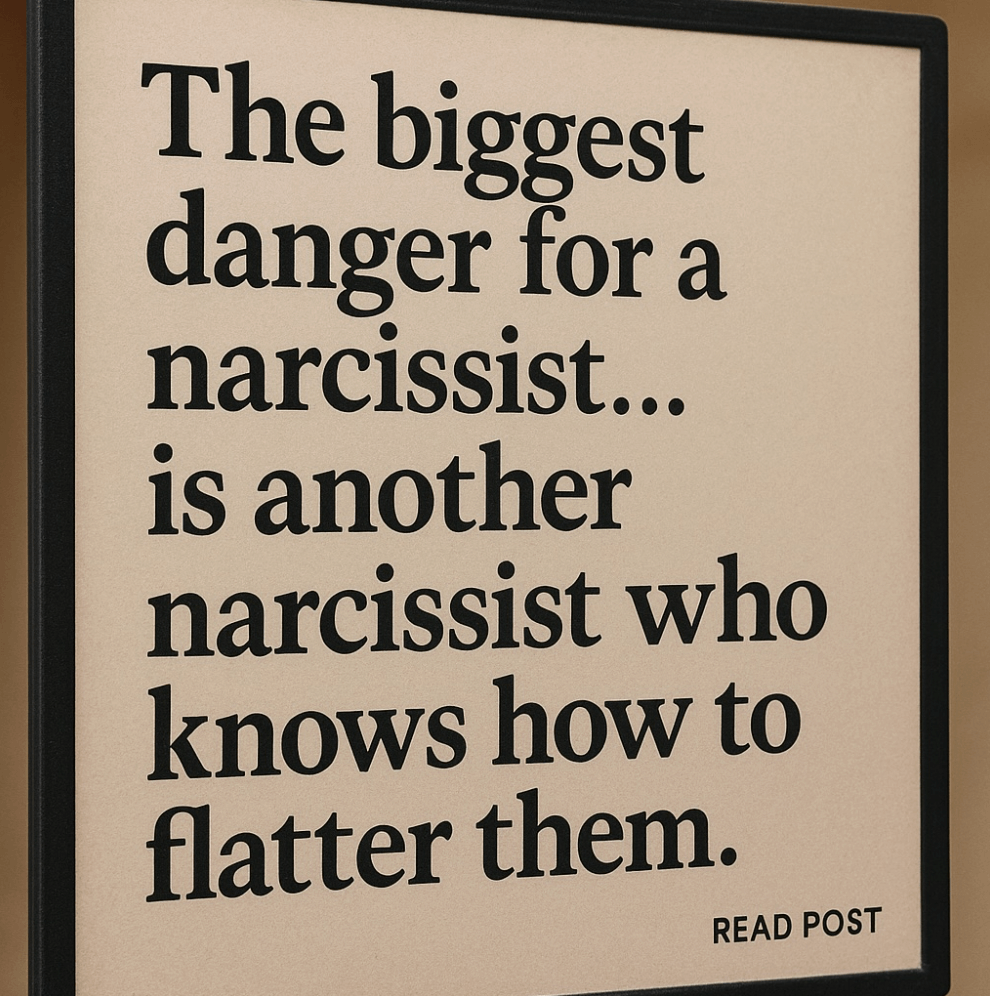
Most people think narcissists are always the ones pulling the strings.
What’s the Hidden Danger Here?
But here’s the danger no one tells them:
A narcissist can be easily manipulated by another narcissist, through praise. Because when your self-worth depends on compliments, flattery becomes a weapon. One narcissist knows exactly how to feed the other’s ego… and before long, the one who looked so powerful is quietly being controlled.
Is This Really Strength?
It’s not strength.It’s a cycle.
And this is what a narcissist has to watch out for most:
Getting trapped in someone else’s loop of praise and manipulation. It’s not just narcissists. Every one of us has a part that craves praise. And if we’re not careful, that part can be used against us too.
The blog lists all the difference patterns to study, understanding patterns is how one can develop 'Daas' [felt knowing]. Content does not provide medical services or professional counseling, and it is not a substitute for professional medical care.
Questions people ask
Can a narcissist manipulate another narcissist?
Yes. The post says a narcissist can be easily manipulated by another narcissist, through praise. When your self-worth depends on compliments, flattery becomes a weapon. One narcissist feeds the other’s ego, and the one who looked powerful ends up quietly controlled. It’s not strength, it’s a cycle.
Why does praise make someone easy to control?
Because when self-worth depends on compliments, flattery becomes a weapon. The post explains that a narcissist can feed another person’s need for praise until the one who looked powerful is quietly controlled, trapped in someone else’s loop of praise and manipulation.
Is craving praise only a narcissist’s problem?
No. The post says it plainly: it’s not just narcissists. Every one of us has a part that craves praise, and if we’re not careful, that part can be used against us too. Noticing that part in yourself is the first step of awareness.
Is people-pleasing the same thing as being kind?
No. The post ends by saying people-pleasing isn’t kindness. Wanting to keep others happy so you get praise, or to avoid conflict, often comes from that same part that craves approval. Seeing this honestly opens room for self-compassion and healthier boundaries.
Comments
Comments are reviewed before they appear. Your email is never published.
Optional analytics help NextSelf understand what writing helps readers most.Optional analytics cookies.