

The Torah that G-d gave to Moses and the Jewish people at Sinai contained two parts:
The Written Torah (the Five Books of Moses), and the Oral Torah, which explains how the Written Torah is lived, understood, and applied.
How was the Oral Law passed down before it was written?
From the days of Moshe Rabbeinu (Moses) until the time of Rabbeinu Hakadosh, the Oral Law was not written as a public text.
Instead, the leading authority of each generation, whether the head of the Sanhedrin (supreme court) or the prophet of that time, would receive the tradition from his teachers and transmit it orally to the people.
What did individual scholars write in their private notes?
Individual scholars might keep private notes for themselves, recording what they had understood from their teachers’ explanations of the Torah and its laws.
These personal writings included:
1. Traditions received from earlier generations
2. And new legal rulings developed in each generation using the thirteen principles by which the Torah is interpreted
These rulings were brought before the Sanhedrin (supreme court), debated, and accepted when approved. This system remained in place from the time of Moshe until the era of Rabbeinu Hakadosh, around 150 years after the destruction of the Second Temple.
Why did Rabbeinu Hakadosh compose the Mishnah?
What Changed in the Time of Rabbeinu Hakadosh?
Rabbeinu Hakadosh saw that this system could no longer last. Students were becoming fewer. Suffering and instability were increasing.
The Roman Empire was expanding its rule and the Jewish people were becoming scattered across distant lands.
He feared that if the Oral Law remained only oral, it would be forgotten. So he gathered all the traditions, all the laws, and all the explanations that had been transmitted from Moshe Rabbeinu and from the courts of every generation after him. From this massive body of teaching, he composed the Mishnah.
How did the Mishnah reach the whole Jewish people?
He taught it publicly, until it became well known throughout Israel. The people then wrote it down and spread it everywhere. Rabbeinu Hakadosh and his court devoted their lives to teaching it, so that the Oral Torah would remain available to all and would never be lost.
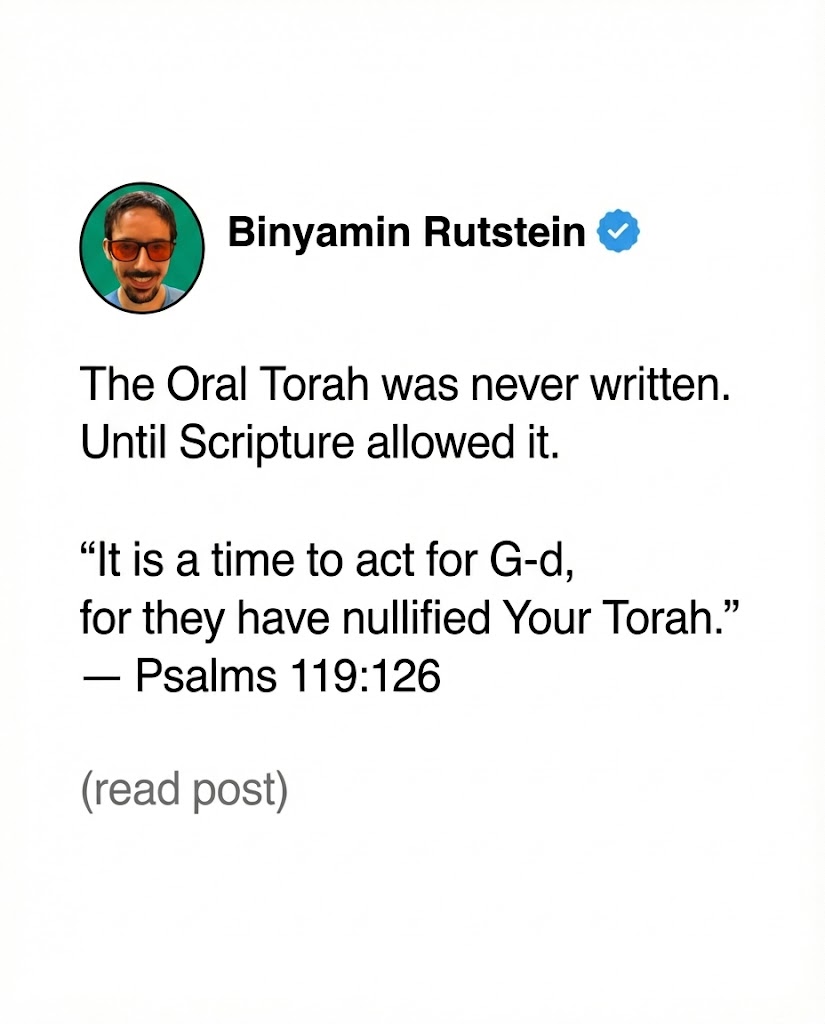
Scripture itself gave permission for this step: “It is a time to act for G-d…” – Psalms 119:126.
What does repairing relationships have to do with G-d?
A Teaching That Reveals the Depth of the Oral Torah
Based on a teaching of the Lubavitcher Rebbe:
When human beings repair relationships, when they choose honesty, responsibility, forgiveness, and care, they heal more than just each other.
They repair the relationship between creation and its Source, the Creator of the universe.
This repair work is like bringing an atonement offering on behalf of G-d for the suffering humanity experienced through creation.
This is one example of how the Oral Torah reveals the inner meaning of human action, responsibility, and relationship.
Source note: This post is based on a paraphrasing of the Rambam’s introduction to Mishneh Torah.
“The Oral Torah was never written. Until Scripture allowed it. “It is a time to act for G-d, for they have nullified Your Torah.” – Psalm 119:126″
Questions people ask
What is the difference between the Written Torah and the Oral Torah?
The Written Torah is the Five Books of Moses. The Oral Torah is the part that explains how the Written Torah is lived, understood, and applied. The Torah that G-d gave to Moses and the Jewish people at Sinai contained both, as two parts of one whole.
What is the Mishnah?
The Mishnah is the collection Rabbeinu Hakadosh composed from the Oral Torah. He gathered all the traditions, all the laws, and all the explanations that had been passed down from Moshe Rabbeinu and from the courts of every generation after him, and shaped that massive body of teaching into one work.
When was the Mishnah written down?
The Mishnah took shape in the time of Rabbeinu Hakadosh, around 150 years after the destruction of the Second Temple. He composed it, and the people wrote it down after he had taught it. Until then the same oral system had run all the way from the days of Moshe Rabbeinu.
Which verse gave permission to write the Oral Torah?
Psalms 119:126: “It is a time to act for G-d.” Rabbeinu Hakadosh feared that an Oral Law kept only in speech would be forgotten, as students grew fewer, suffering increased, and the Jewish people were scattered across distant lands. Scripture itself gave permission for the step.
“The Oral Torah was never written. Until Scripture allowed it. “It is a time to act for G-d, for they have nullified Your Torah.” — Psalms 119:126”
Explore the NextSelf Blog. Start with this post explaining the world of souls. And my Youtube. Content is published to this facebook first and a few days later, to the blog.
The blog lists all the difference patterns to study, understanding patterns is how one can develop 'Daas' [felt knowing].
Update: As awe, trust, and love deepen, they can allow greater openness and intimacy with the Creator. That intimacy can include sadness when you notice how much more of His goodness can be revealed.