

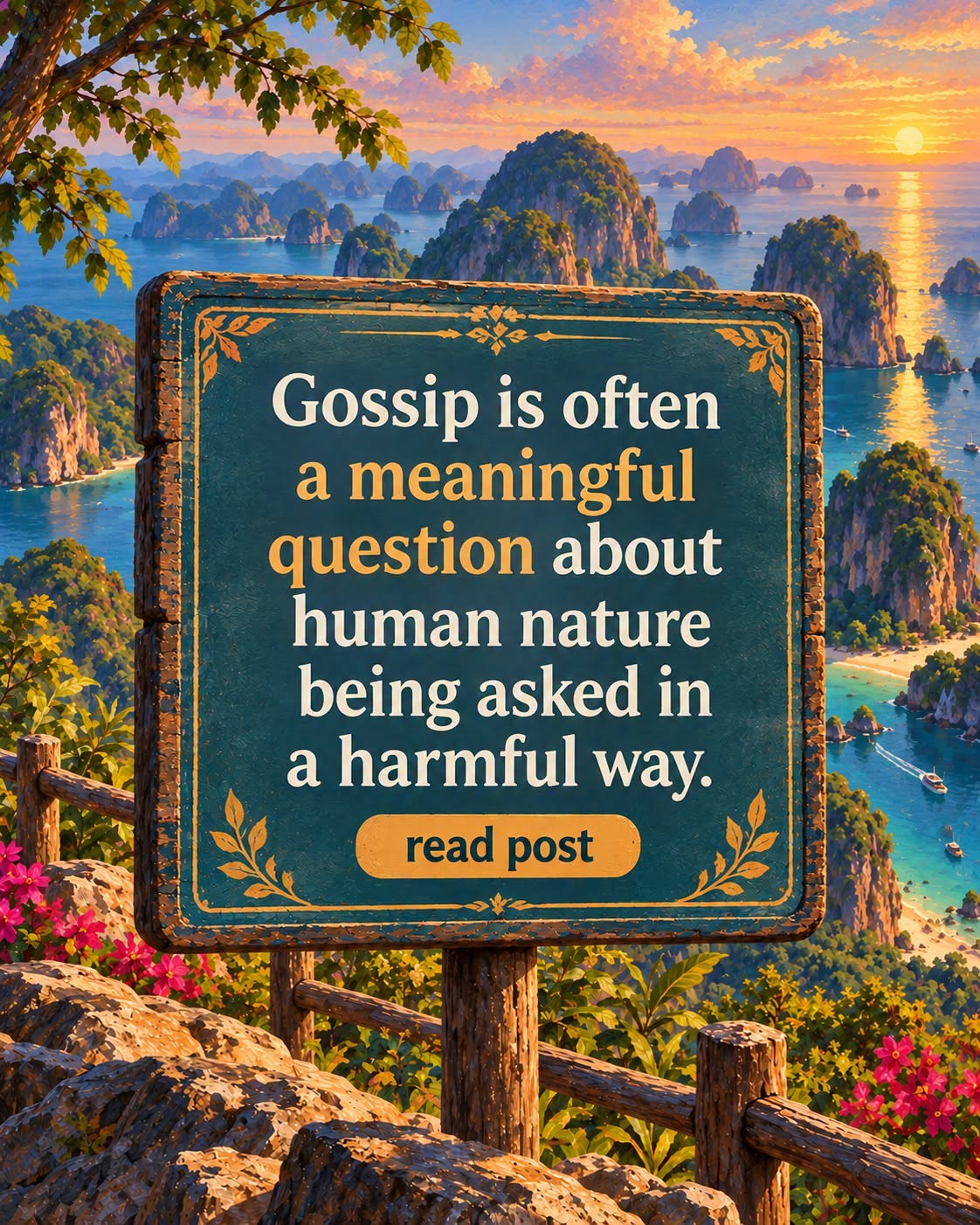
Gossip doesn't always need to be stopped by blocking curiosity. It can be transformed by giving curiosity a better purpose.
How can one simple question sometimes stop gossip?
You can sometimes stop gossip with one simple question:
"What questions about human nature or how relationships work do you have?"
People often gossip because they are curious about why someone behaved a certain way.
What are people really curious about when they gossip?
Why would someone lie to a person they love? Why do people become jealous? Why do some people keep choosing unhealthy relationships? Why do some people feel emotionally numb, even around people they love?
These are meaningful questions. But gossip turns that curiosity into a conversation about another person's private life, often without enough information to understand their story.
Instead of discussing whether someone is selfish, controlling, or immature, we can explore why people develop those patterns.
That changes the purpose of the conversation.
We are no longer trying to decide what kind of person someone is. We are trying to understand human nature with greater wisdom and compassion.
And when we understand why people behave in harmful ways, we can become better at noticing those patterns, setting boundaries, and building healthier relationships.
What does Chassidus teach about transforming what hides G-dliness?
Sometimes the best way to stop gossip is not to end the conversation, but to give the curiosity behind it a better direction.
This connects to a deeper idea in Chassidus [Jewish mysticism, psychology, and philosophy].
In the Chanukah Maamer talk Lehavin Inyan Neiros Chanukah (5726), the Lubavitcher Rebbe explains how Pnimiyus Atik [deep truths], connected to the deepest level of Divine pleasure (taanug), can transform kelipah [what hides G-dliness].
A powerful spiritual light [like acts of justice] can break through darkness. But Pnimiyus Atik reveals something deeper, the Creator's Essence, which is beyond all limits.
Acts of justice can stop harmful behavior without changing the desires behind it. But revealing a deeper truth can help a person understand those desires and choose to use them for goodness.
This is how what once hid G-dliness [the Creator's goodness becoming part of how we live and treat others] can become a way to express it.
How can the same curiosity serve a better purpose?
We can apply this idea to gossip. Instead of fighting someone's curiosity, we can help that same curiosity become a way to understand human nature with greater wisdom and compassion.
The curiosity doesn't need to disappear. Its purpose can change.
We can use a similar approach when we notice a selfish desire.
How do you transform a selfish desire instead of fighting it?
Instead of fighting the desire, we can remind ourselves [or another]:
"I'm busy working on my mental, physical, and spiritual health. The more I work on these areas, the more meaningful life feels."
One spiritual idea that can help [to share] is that the Creator doesn't need anything from us. He freely chose to give us existence and the ability to build a relationship with Him.
When we focus on that relationship, our desires can begin to transform. We can find deeper pleasure in learning wisdom, caring for our bodies, setting healthy boundaries, and expressing compassion.
The goal isn't simply to stop doing harmful things. It's to build a life where goodness becomes more meaningful and enjoyable than the harmful desires we once followed.
_________________
Related guides:
How to transform the guilt from gossip
Deep emotional healing explained
Transforming unhealthy sexual fantasies: https://www.facebook.com/share/p/1F68PyioT4/
Why is selfish desire apart of creation?
Healing emotional numbness
#NextSelf #kabbalah #transformation #HealingJourney
“Gossip is often a meaningful question about human nature being asked in a harmful way.”
Explore the NextSelf Blog. Start with this post explaining the world of souls, and what does it mean to be light? And my Youtube. Content is published to this facebook first and a few days later, to the blog.
The blog lists all the difference patterns to study, understanding patterns is how one can develop 'Daas' [felt knowing].
Content does not provide medical services or professional counseling, and it is not a substitute for professional medical care.