

Chassidus explains why.
The goal of spiritual growth is not only to know the truth.
It is to improve your personality so you can reveal more goodness in the world.
Why do believers still feel afraid, ashamed, or uncertain?
Why?
Because creation means experiencing yourself as separate from the Creator.
That feeling of separation makes it possible to also feel alone, afraid, ashamed, and uncertain.
Adam and Eve were the first humans to experience what happens when those feelings are not yet met with developed emotional skills.
Without those skills, the nervous system naturally reaches for survival patterns to regain a sense of safety.
Chabad Chassidus teaches that this was part of the design of creation.
The Creator did not create human beings only to receive goodness.
He created us to become co-creators by developing the emotional skills that transform separation into relationship.
That effort also means the pleasure of the World to Come [era of world peace and goodness] will not feel like an unearned gift.
We will be able to enjoy that closeness [intimacy] without shame because we helped build the relationship through the work of learning how to trust, relate, and reveal goodness.
What are light and vessels in Chassidus?
Chassidus explains that every human relates to the Creator through both light and vessels.
Light is the Creator’s way of relating to us.
It carries a way of experiencing reality.
“Light is a metaphor of the Creator's desire to be perceived [in a world of form].” - Rabbi YY Jacobson.
Vessels are our personality and emotional skills. They decide how much of that light we can receive and express.
As our emotional skills grow, our vessels become stronger.
They can contain deeper levels of the Creator’s light.
One level of light says:
“I’m here to channel goodness.”
A deeper level [more humility] says:
“My Source is far greater than anything I can reveal.”
“One thing I ask of the Creator… to behold the beauty of the Creator.” — Psalms 27:4
A deeper level still says:
“I miss my Source.”
The Baal Shem Tov taught that a person is where their desire is.
So when you deeply miss the Creator, that longing itself brings you closer to Him and helps you become a clearer channel for goodness.
Sometimes goodness means caring for yourself; sometimes it means giving kindness to someone else.
The deeper our vessels become, the deeper our relationship, intimacy, and pleasure become.
What is daas, the felt knowing Chassidus teaches?
But emotional skills do not grow from information alone.
The truth has to become real enough that your nervous system can live by it.
__________________
Chassidus teachings were reignited by Rabbi Yisrael Baal Shem Tov in the year 1734 after years of seclusion and after they were mostly lost from the Jewish people because of centuries of persecution.
──────────
That is why Chassidus places so much emphasis on daas [felt knowing], when truth becomes real enough to change how you react.
Faith develops into this kind of knowing through curiosity, analysis, and repeatedly noticing patterns in your own life and around you.
As that truth becomes more real, it gives you enough inner trust to practice emotional skills like curiosity, compassion, healthy boundaries, and self-forgiveness.
Psalms by King David gives language for pleading with the Creator for help developing those skills.
“Let me know Your paths, [Creator]; teach me Your ways.” — Psalms 25:4, a plea for curiosity.
“Guide me in Your true way and teach me, for You are G-d, my deliverer; it is You I look to at all times.” — Psalms 25:5, a plea for boundaries.
“Create for me a pure heart, G-d, [so that I do not stumble again].” — Psalms 51:12, a plea for compassion and self-forgiveness.
“Why do You sleep, my [spark of] G-d? Wake up! Arise and motivate me once again.” - A plea for motivation.
Those emotional skills help you respond differently when you feel overwhelmed instead of automatically falling into survival mode.
How do survival patterns shape your relationships?
One of the most important patterns to recognize is how you seek safety and control in your relationships.
Many of those patterns are adaptive nervous system responses.
They helped you survive difficult experiences in early childhood and give a felt sense of control, but they can also make trust and intimacy more difficult as an adult.
1. Fight (which often shows up as narcissism) believes, “If I become stronger, more right, or more intimidating, I’ll feel connected again.”
2. Flight (which is avoidance) believes, “If I avoid this, I’ll feel connected again.”
3. Freeze (which looks like inaction or shutdown) believes, “Nothing I do about the situation will matter.”
4. Fawn (which is people-pleasing) believes, “If everyone is happy with me, I’ll feel connected again.”
These patterns can become so automatic when you feel overwhelmed that they start to feel like your personality.
──────────
Ask yourself:
1. Where do I resist goodness?
2. Where do I hide from responsibility?
3. Which survival pattern do I rely on most?
4. What belief keeps repeating beneath it?
5. When do I stop being curious and assume I already know what will happen?
This kind of knowing does not begin with having all the answers.
It begins by becoming curious enough to analyze your life and recognize patterns.
As you analyze those patterns, you can also begin noticing something larger:
The experiences that showed you where you struggle can become the exact places where you learn new emotional skills.
How does trust weaken the need for control?
The more patterns you recognize, the more you begin to trust that your life is not random, but part of the Creator’s plan.
──────────
As trust grows, the need to control begins to weaken.
1. Fight no longer needs to prove itself.
2. Flight no longer needs to avoid.
3. Freeze no longer believes nothing you do about the situation will matter.
4. Fawn (which is people-pleasing) no longer needs everyone’s approval.
Instead of trying to create connection through control, you begin finding connection in your relationship with the Creator.
As that relationship becomes safer and stronger, it gives you more strength to keep practicing curiosity, compassion, boundaries, and self-forgiveness when life becomes difficult.
As those emotional skills grow, trust deepens, your personality changes, and your survival patterns become weaker.
And as survival mode becomes weaker, you have more emotional space to notice the Creator instead of only noticing what feels threatening.
──────────
From there, awe begins to grow.
What is awe, and how does love grow from it?
Awe is the awareness that you are before the Creator right now.
It awakens wonder that the Source of all existence is present.
It awakens humility because His existence and wisdom are infinitely greater than what you can understand or express.
And it awakens healthy fear because your choices matter in His presence.
From awe, love begins to grow as you trust that the Creator is good.
Love brings joy from feeling closer to Him.
It also brings sadness because His goodness can always be more revealed.
Expressing appreciation helps deepen both awe and love because it trains you to notice the Creator’s goodness more clearly.
The more you notice and appreciate that goodness, the more you long to reveal it in yourself and in the world.
The deeper your awe and love become, the deeper your relationship with the Creator becomes.
As awe and love become more stable, closeness with the Creator itself becomes a source of joy.
Chassidus teaches that the deepest pleasure is intimacy with the Creator.
Survival patterns [like people-pleasing] teach us to trust control more than relationship.
Daas [felt knowing] grows as you repeatedly notice patterns of infinite wisdom in your life and in the world.
As those patterns become more real to you, you begin to trust relationship more than control.
Without that kind of knowing, spiritual ideas can stay in the mind.
With it, what you keep noticing begins to shape your personality, your relationships, and the way you experience the Creator.
──────────
The Lubavitcher Rebbe taught that every person has a role in preparing the world for the Messianic era [world peace].
One of the deepest ways we do that is by building a genuine relationship with the Creator.
How is a relationship with the Infinite different?
A relationship with another human often begins with curiosity.
You notice something about them, ask questions, and slowly understand who they are.
Understanding grows by noticing differences:
1. “They think differently than I do.”
2. “They respond differently than I expected.”
3. “I’m learning who they are by seeing how they are not me.”
A relationship with the Infinite begins differently.
You cannot fully understand the Creator by comparing Him to something else.
Awe begins that relationship with the Infinite.
Love deepens it.
Joy grows from the closeness.
The more we replace control with trust, and survival with relationship, the more we become the kind of people who can help build a world of revealed goodness.
__________________________
Related guides:
A melody can help change your personality: (The Sixth Chabad Rebbe)
Every world view contains mysteries, some are more reasonable then others: (The biggest question in spirituality)
How you explain suffering shapes how you experience trust:
(Believing you deserve to suffer)
Extreme people pleasing and misguided awe are like idol worship: (Misdirected awe)
What happens in the world of souls? (Maimonides on the World to Come)
Emotional numbness stops people from feeling awe and love: (Emotional numbness can hide sadness)
Questions people ask
Can you believe in the Creator and still struggle with fear or shame?
Yes. Chassidus explains that creation means experiencing yourself as separate from the Creator, and that feeling of separation makes it possible to feel alone, afraid, ashamed, and uncertain. Without developed emotional skills, the nervous system reaches for survival patterns to feel safe, so strong belief can live beside real struggle.
What is daas [felt knowing] in Chassidus?
Daas is felt knowing, when truth becomes real enough to change how you react. Faith grows into this kind of knowing through curiosity, analysis, and repeatedly noticing patterns in your own life. With daas, spiritual ideas stop staying only in the mind and begin to shape your personality and relationships.
What are the four survival patterns in relationships?
They are fight (which often shows up as narcissism), flight (which is avoidance), freeze (which looks like inaction or shutdown), and fawn (which is people-pleasing). Each one is an adaptive nervous system response that helped you survive early experiences, but as an adult it can make trust and intimacy harder.
How do survival patterns like people-pleasing become weaker?
They weaken as trust grows. Chassidus teaches that repeatedly noticing patterns of infinite wisdom in your life builds daas [felt knowing], which gives you enough inner trust to practice curiosity, compassion, healthy boundaries, and self-forgiveness. As that trust deepens, the need to control weakens and connection replaces survival mode.
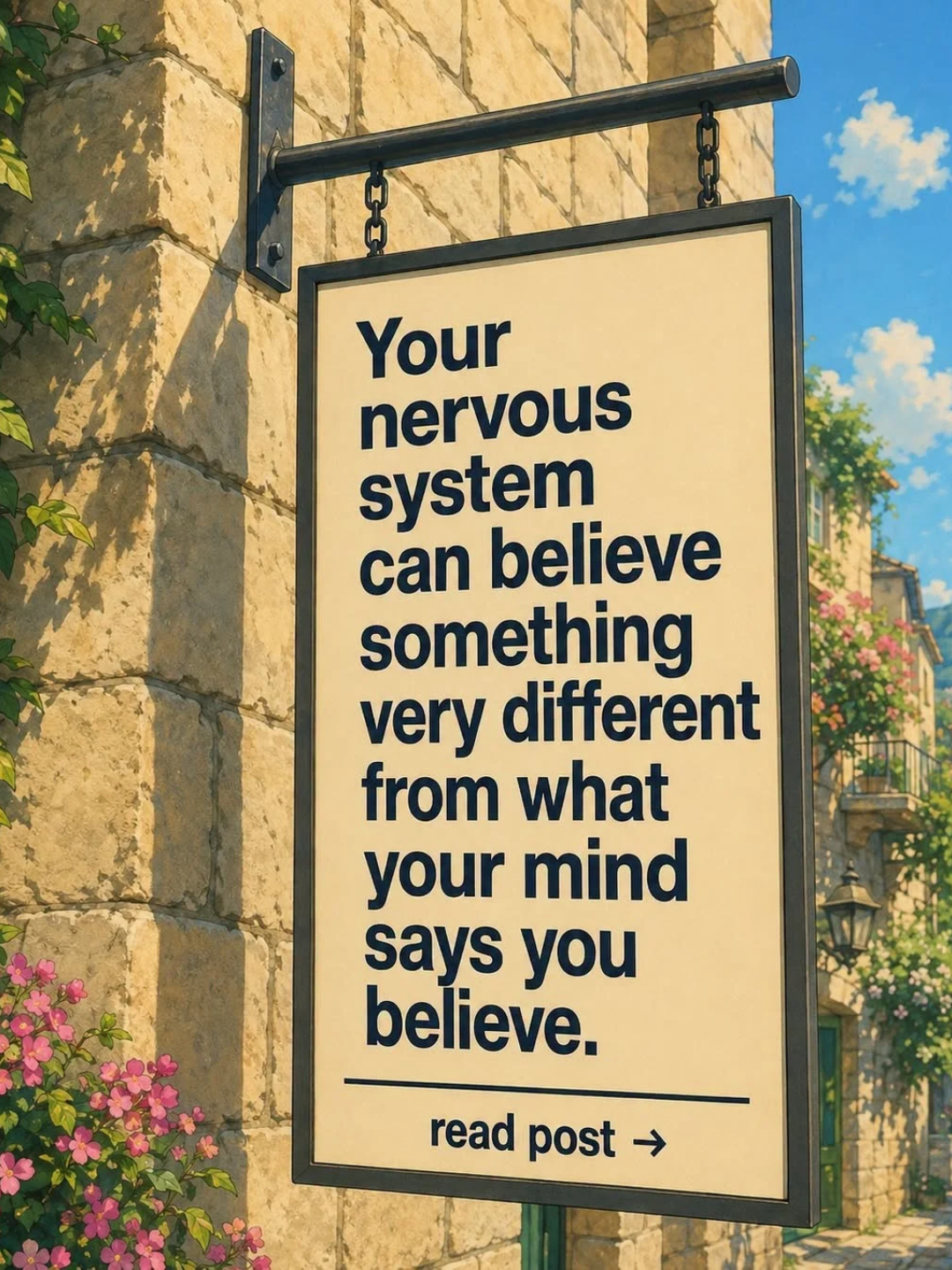
“Your nervous system can believe something very different from what your mind says you believe.”
Explore the NextSelf Blog. Start with this post explaining the world of souls. And my Youtube.
The blog lists all the difference patterns to study, understanding patterns is how one can develop 'Daas' [felt knowing].
Update: As awe, trust, and love deepen, they can allow greater openness and intimacy with the Creator. That intimacy can include sadness when you notice how much more of His goodness can be revealed.