

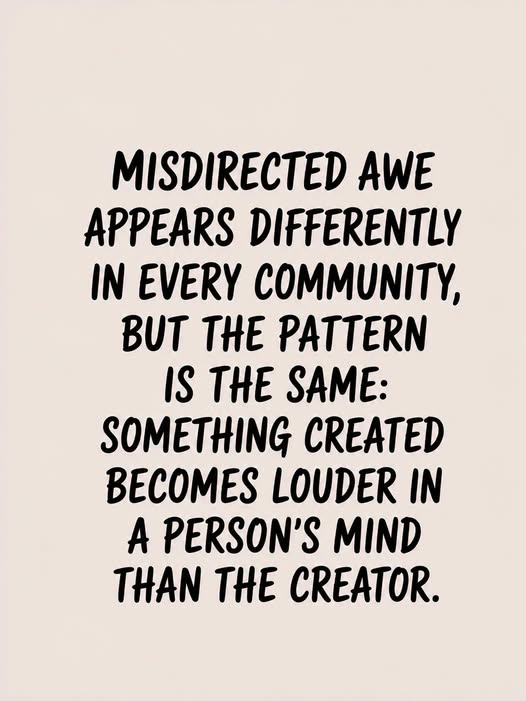
Misdirected awe appears differently in every community.
In some places, it may attach to money, status, success, politics, or social approval.
In religious communities, it can attach to a spiritual leader, land, teacher, or talmid chacham, a student of wisdom.
What is the real problem with misdirected awe?
The issue is not always the person being respected.
The issue is when the awe that belongs to the Creator becomes centered on a human being.
What does healthy awe toward the Creator feel like?
Awe toward the Creator is not blind fear.
It begins with fear and wonder.
Fear, because my choices truly matter before Him.
Wonder, because the Infinite Creator wants human beings to freely reveal goodness in His world, and our choices give Him pleasure without changing Him.
That awe awakens love.
Love wants greater closeness with Him. As awe, trust, and love deepen, they can allow greater openness and intimacy with the Creator. That intimacy can include sadness when you notice how much more of His goodness can be revealed.
_________________________
How does this awe build your relationship with G-d?
That awe is what builds a person’s relationship with the Creator.
It trains a person to live before Him, speak honestly with Him, and notice His greatness during prayer and throughout the day.
Prayer means pleading with the Creator and expressing appreciation before Him.
Is it wrong to have awe for a teacher?
Jewish law may allow awe toward a talmid chacham, but that does not mean it should become the focus of a person’s inner life.
A talmid chacham can help a person notice Hashem, the Creator, more deeply, but he should not become the object of that awe.
"Extreme people-pleasing can become like idol worship because it trains a person to become like an idol: silent, willing to put up with anything, and unable to say no." — Tzvi Hirsch of Nadvorna [student of the Maggid of Mezeritch]
Extreme misdirected awe can also become like idol worship, but through a different pattern.
What does misdirected awe look like inside a person?
The person starts having more inner conversation with a human being than with the Creator.
They think more about what the person would say, what the person would think, what the person would approve of, or how the person sees them.
Instead of living before Hashem, they begin living before the image of a human being.
That weakens the person’s direct relationship with the Creator.
The purpose of a talmid chacham, a student of wisdom, is to help people notice Hashem’s greatness more deeply, not to become the primary focus of their awe.
"Misdirected awe appears differently in every community, but the pattern is the same: something created becomes louder in a person's mind than the Creator."
________________
Related guides:
Based on a story of the Besht, It’s better to have misguided awe (faith) toward a spiritual leader than toward wealth and power, because faith demands some humility.
An idea to help relate to the Creator after suffering: You can have good arguments and still struggle with fear, shame, or people-pleasing
How does the world of souls work? Maimonides [Rambam] describes the World to Come as fully spiritualExplore the NextSelf Blog. Start with this post explaining the world of souls, and what does it mean to be light? And my Youtube. Content is published to this facebook first and a few days later, to the blog.
The blog lists all the difference patterns to study, understanding patterns is how one can develop 'Daas' [felt knowing].
Content does not provide medical services or professional counseling, and it is not a substitute for professional medical care.