

The same freedom that allows a person to create enormous suffering also allows them to become a partner in revealing goodness.
To understand why that kind of freedom exists, it helps to first ask what creation would look like if it were simply an expression of love.
Love wants closeness, goodness, and connection. A world that was simply an expression of love would not need to contain the possibility of extreme fear, loneliness, cruelty, or suffering.
But Chassidus [Jewish mysticism] describes creation as something deeper than the Creator simply expressing love.
Creation comes from His free choice.
He did not create because He was missing something or because something forced Him to create [His Essence does not lack wisdom, compassion, or love].
He freely chose to create a world where human beings could experience themselves as separate from Him, with their own needs, desires, fears, and choices.
The surprising claim of Chassidus is that even this choice ultimately expresses compassion. To understand why, we have to look at what separation makes possible.
[linked post at the end: why there must be one cause of existence or nothing would exist, and why it is reasonable to believe that Source does not lack intelligence]
_____________
How does separation make survival mode and suffering possible?
For real free choice to exist, separation has to feel real.
A human being has to be able to experience:
“I need to protect myself.”
“I need to survive.”
“What do I need?”
“What can I control?”
That makes survival mode possible.
Survival mode does not only look like obvious fear or aggression. It can also look like people-pleasing, avoiding difficult conversations, staying silent to prevent conflict, trying to control how other people feel about you, or disconnecting from what you really want because rejection feels too dangerous.
And once survival mode is possible, suffering is also possible.
People can become overwhelmed. They can hurt themselves. They can hurt each other. They can use their intelligence and free choice to create more suffering instead of more goodness.
You could not simply remove most suffering while keeping human nature and free choice exactly the same. To make extreme suffering impossible, human beings themselves would have to be different.
_____________
What can survival mode be transformed into?
But survival mode is not the purpose.
The purpose is what survival mode can be transformed into.
“I need to survive” can develop into:
“I have responsibilities.”
“What can I control?” can develop into:
“How can I use my choices well?”
“What can I get from you?” can develop into:
“How can we have a real relationship?”
People-pleasing can develop into healthy boundaries.
Avoiding difficult conversations can develop into learning how to communicate honestly.
Fear can develop into awareness.
Self-protection can develop into healthy relationship.
Desire can develop into love.
Separation can develop into intimacy [oneness].
How do emotional skills help us become co-partners in creation?
This is one way we become co-partners in creation.
We develop the emotional skills needed to transform survival into relationship and responsibility. We learn awareness, boundaries, honest communication, compassion, and how to handle difficult feelings without automatically hurting ourselves or other people.
This is also what spirituality is about: improving your personality.
Spirituality is not only about learning ideas about the Creator. Those ideas are meant to change how you live, relate, and respond.
Healthy spiritual ideas help you develop emotional skills and allow you to feel deeper awe, love, and bliss. Unhealthy spiritual ideas can do the opposite. They can keep the nervous system stuck in guilt, worry, and toxic shame instead of helping a person grow into relationship and responsibility.
Through that work, we help build the relationship instead of receiving it automatically.
Chassidus explains that this allows us to enjoy the future world of goodness without feeling like we were simply handed something we had no part in creating. We used our own choices to help build the relationship we eventually experience.
We did not only receive goodness.
We used our own choices to help reveal it.
_____________
How can the physical world become part of the Creator’s purpose?
And the compassion goes even deeper than that.
The goal is not only for human beings to become kinder or more spiritual. According to Chassidus, the physical world itself can become part of the Creator’s deepest purpose.
The Torah describes the human body as coming from dust. Dust represents the lowest physical reality.
Yet that body can give charity, comfort another person, raise a child, speak honestly, perform a mitzvah, and use physical life in ways that express goodness and relationship with the Creator.
Something completely physical can become part of something infinitely deeper.
In the language of Chassidus [Chabad], the lowest physical reality can become united with His Essence.
The Creator did not only give creation the ability to express Him. He chose that even ordinary physical life could become part of His deepest purpose.
This also happens on the level of humanity as a whole.
People and nations do not have to lose their personalities or traditions.
When different nations can remain genuinely different and still live in deep friendship, their unity does not require everyone to become the same.
Chassidus uses this kind of unity as a limited human picture for something much deeper in the Creator.
Our choices can be meaningful to Him without filling a need in Him.
When Chassidus speaks about the Creator receiving pleasure from creation, it does not mean He was lacking pleasure beforehand. It means He freely chose for our actions and our relationship with Him to matter.
At one level, Chassidus gives us a human metaphor: awe and love united like inseparable friends.
But as we try to speak about the Creator’s Essence more deeply, even words like awe, love, unity, and intimacy become laughably limited.
They describe our relationship with Him. They do not describe what He is.
No human idea can describe His Essence.
_____________
How does Chassidus say creation becomes part of the Creator’s unity?
This is where the idea of intimacy becomes even deeper.
Because everything ultimately comes from Him, the deepest purpose is not merely a relationship between two completely independent realities.
Chassidus describes creation ultimately becoming part of His unity.
I think of this as the Creator choosing intimacy with Himself through a world that first experiences separation.
That does not mean human individuality has no purpose. The whole structure depends on human beings experiencing real personality, real choices, real relationships, and real responsibility.
Intimacy also requires belief and trust.
A person has to believe that the Creator is real, trust that He is good, and then choose to use physical life in a way that becomes part of His purpose.
That is an extraordinary expression of compassion.
The lowest reality is given the potential not only to express Him, but to become united with His Essence and become part of His purpose: intimacy with Himself.
_____________
What is the larger picture behind the possibility of suffering?
That is why the possibility of suffering exists inside a much larger picture.
The Creator freely chose a world where separation could feel real.
That allowed survival mode to become possible.
It allowed people to live from fear, people-please, avoid conversations, control, withdraw, hurt each other, and use free choice badly enough to create enormous suffering.
But it also created the possibility for something much deeper.
Survival can become responsibility.
People-pleasing can become boundaries.
Avoidance can become honest conversation.
Self-protection can become healthy relationship.
Separation can become intimacy [oneness].
Different nations can keep their personalities and traditions and still become friends.
And physical dust, the lowest reality, can become united with the Creator Himself and become part of His purpose: intimacy with Himself [through acts of goodness and kindness].
That is a very deep kind of compassion.
Not only giving existence goodness.
Giving the lowest form of existence the possibility of becoming united with His Essence.
______________________
Related guides:
How to develop the desire to feel deeper awe and love: https://www.facebook.com/share/p/1KzDpb7hPn/
The Lubavitcher Rebbe taught that every person has a role in preparing the world for the Messianic era [world peace].
One way we do that is by building a real relationship with the Creator and helping others build one too [a relationship begins when one notices His greatness and feel awe, if you trust He is good, love can be felt].
The Rebbe taught:
“If you know Alef, teach Alef.”
You do not need to know everything before sharing what you understand. If a Torah idea helps you notice the Creator more deeply, share it.
The Rebbe also taught:
“We must recount and share with others the nearness of G-d that we experience.”
When something gives you more awe, trust, love, or awareness of His closeness, sharing it can help someone else notice Him too.
There has to be one source for existence or nothing would exist
Billions of people have this misguided belief about the Creator: https://www.facebook.com/share/p/1AxdZngruQ/
How to transform worry and guilt about the past into love
You can believe life is meaningful but not feel the meaning
How was suffering built into creation? [psychology +philosophy] https://www.facebook.com/share/p/1d6EkWMwp3/
How does a relationship with the Creator begin?
#NextSelf #kabbalah #biblestudy #spiritualgrowth
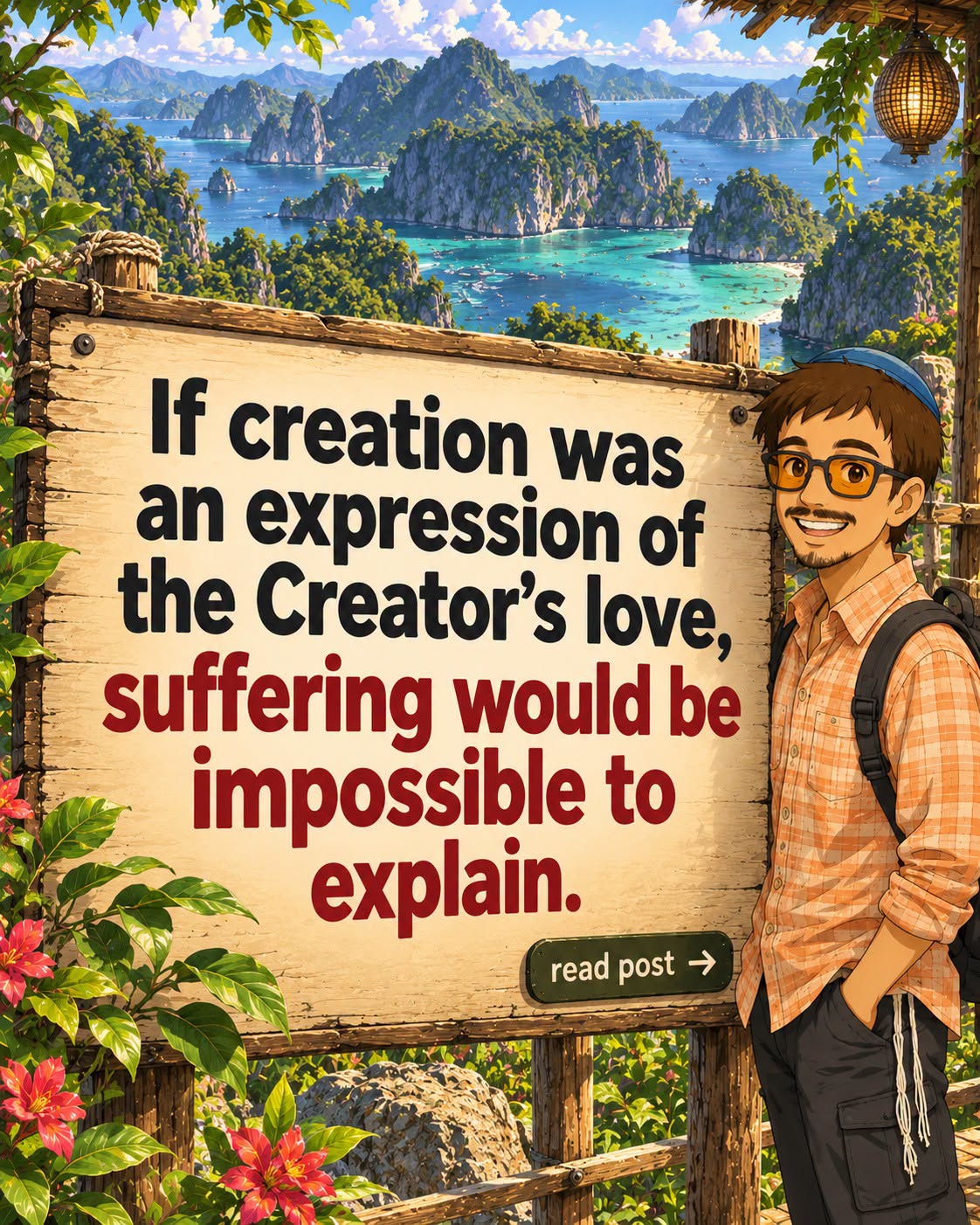
“If creation was an expression of the Creator’s love, suffering would be impossible to explain.”
Explore the NextSelf Blog. Start with this post explaining the world of souls. And my Youtube. Content is published to this facebook first and a few days later, to the blog.
The blog lists all the difference patterns to study, understanding patterns is how one can develop 'Daas' [felt knowing].
Update: As awe, trust, and love deepen, they can allow greater openness and intimacy with the Creator. That intimacy can include sadness when you notice how much more of His goodness can be revealed.