

to believe in an Infinite Creator and still trust that He is good.
That structure is relationship and responsibility.
Not control.
Not blind positivity.
Not pretending suffering does not exist.
Relationship and responsibility.
Because the kindest way to give is not always to hand someone everything without their participation.
That can crush the self-respect of the recipient and make the person feel unimportant, dependent, passive, or ashamed.
The deepest giving protects dignity.
It allows the recipient to become part of receiving the gift.
______________________
What Do Light and Vessels Mean in Kabbalah?
That is why Kabbalah explains that creation began with light and vessels.
The light represents The Creator’s desire to give goodness and be revealed through that goodness.
The vessels represent the created world’s ability to receive, hold, and express that goodness.
But in the beginning, there was more light than the vessels could contain.
That was not a flaw in the design, it allowed ego to exist, your send of “I”.
It was the beginning of a world where receiving goodness would require growth, choice, effort, repair, humility, and responsibility.
The Creator did not create a world where goodness would simply be handed to us in a way that bypasses our dignity.
He created a world where we could become vessels for goodness.
That is the kindest way to give.
Because when a person becomes a vessel, they are not only receiving; they are participating, becoming responsible, becoming emotionally available, and becoming capable of relationship.
Why Did the Vessels Break?
When creation began with more light than the vessels could contain, it meant the design of creation began with a gap.
The light was available.
The goodness was real.
But the vessels did not yet have the humility to receive all that light as relationship.
Not because the light was bad.
Because created beings cannot hold great goodness unless they know how to receive life and channel goodness.
Without humility, too much goodness does not feel like closeness.
It can feel like overwhelm, exposure, shame, dependence, fear, or loss of self, because the vessel begins to believe that needing goodness means being weak, unimportant, unsafe, or unloved.
The vessel begins to feel alone in front of the goodness instead of in relationship with it.
But The Creator is the source of life, so distancing from the light means distancing from the very source that gives the vessel life.
That is why the vessels broke.
Not because The Creator’s goodness was too much in a negative way.
Because the vessels did not yet have the humility, dignity, responsibility, and relationship-capacity needed to receive that much light without turning inward into survival mode.
_________________
What Does Humility Really Mean?
Humility does not mean feeling worthless.
Humility means knowing: “I am here to receive life from The Creator and channel goodness.”
The structure of the world is relationship and responsibility.
That means a vessel has to practice humility in order to hold goodness.
Humility means staying connected to truth, even when truth makes the personality feel exposed, dependent, or less in control.
That is why people-pleasing and avoiding necessary conversations are not humility.
They are survival patterns.
__________________
Is People-Pleasing the Same as Humility?
A person can look gentle, agreeable, or “selfless,” while actually avoiding the humility of telling the truth.
“Extreme people-pleasing can be like idol worship, because an idol puts up with anything and never says no.” – Tzvi Hirsch of Nadvorna
But relationship requires truth.
So real humility includes honesty, responsibility, boundaries, and the courage to stop worshiping approval.
When a vessel does not practice humility, it shatters.
It cannot hold the light as relationship.
Instead of feeling in relationship with goodness, the created being feels alone in front of goodness.
That is when survival mode becomes possible.
Survival mode is the opposite of humility.
Humility says:
“I receive life from The Creator, and I can stay in relationship while being dependent, responsible, and seen.”
Survival mode says:
“I exist on my own. I have to protect myself alone. I have to make myself important. I have to control how I am seen.”
That is where ego comes from.
__________________
Where Does Ego Come From?
Ego is the experience of separateness.
It is the personality trying to survive after it has lost the felt awareness that The Creator is the source of life.
From there, a person can fight (which often shows up as narcissism), hide, freeze (which looks like inaction or shutdown), perform, people-please, chase approval, avoid honest conversations, or protect an image, because the personality no longer feels in relationship with goodness.
That is what the story of Adam and Eve shows.
After they ate from the Tree of Knowledge, they did not know how to stand honestly before The Creator and still feel loved.
They felt exposed, unseen, ashamed, and afraid of closeness.
They did not know how to say:
“I am so, so sorry. I had this overwhelming need to feel powerful and in control.”
They did not trust that they could stay close to The Creator while feeling unimportant.
So they hid.
That is ego.
Not just arrogance.
Our of control Ego is a personality trying to protect itself when it no longer knows how to practice intimacy.
It hides, blames, covers itself, and tries to stay safe instead of staying honest.
That does not mean the personality is evil.
It means the personality is trying to survive in a world where goodness feels hidden.
How Does a Person Leave Survival Mode?
And getting out of survival mode is not automatic.
It takes work.
A person has to slowly become a vessel again.
That means learning how to tell the truth, take responsibility, repair harm, receive love without shame, choose goodness without ego, and stay in relationship even when feeling exposed, dependent, or afraid.
That is the work of repair.
Not destroying the personality.
Teaching the personality how to receive goodness without going into survival mode.
A healthy personality can hold awareness of The Creator without falling into shame, fantasy, fear, control, blame, hiding, or self-importance.
Because the goodness creation is meant to reveal is so great, it cannot even be imagined from inside our current loneliness, confusion, distance, and pain.
The distance we feel from goodness is so great because the goodness we are becoming vessels for is so great.
Creation is not small.
The purpose of life is not simply to receive comfort, ease, and answers.
A purpose of life is to become vessels for a goodness that is far beyond what the personality can naturally hold.
That is why life includes concealment and goodness can feel distant.
That is why a person can feel lonely, confused, abandoned, ashamed, or cut off from meaning.
Not because The Creator is cruel.
The Creator is not apologizing to anyone for the suffering that came with the design of creation.
The design is bigger than our current understanding.
But He did give human beings the responsibility to repair, reveal, and make room for His goodness inside the very places where it feels hidden.
That is why repairing relationships matters so much.
________________________
Why Does Repairing Relationships Matter So Much?
When one person tells the truth, takes responsibility, repairs harm, forgives what can be forgiven, and restores trust where trust was broken, that is not just emotional maturity.
It is spiritual work.
It is like bringing an atonement offering on behalf of the Creator for the suffering that happened to humanity through creation.
Not because The Creator needs atonement.
Because creation contains pain, and human beings were entrusted with the work of answering that pain through goodness.
When people repair relationships with each other, they become part of the answer to the suffering creation made possible.
They reveal that loneliness was not the final truth.
They reveal that distance can become relationship.
They reveal that broken vessels can become deeper vessels.
A vessel means the ability to hold goodness without losing itself, misusing it, hiding from it, or turning it into ego.
A person becomes more of a vessel when they become more honest, more responsible, more humble, more emotionally available, and more able to choose goodness when goodness is not obvious.
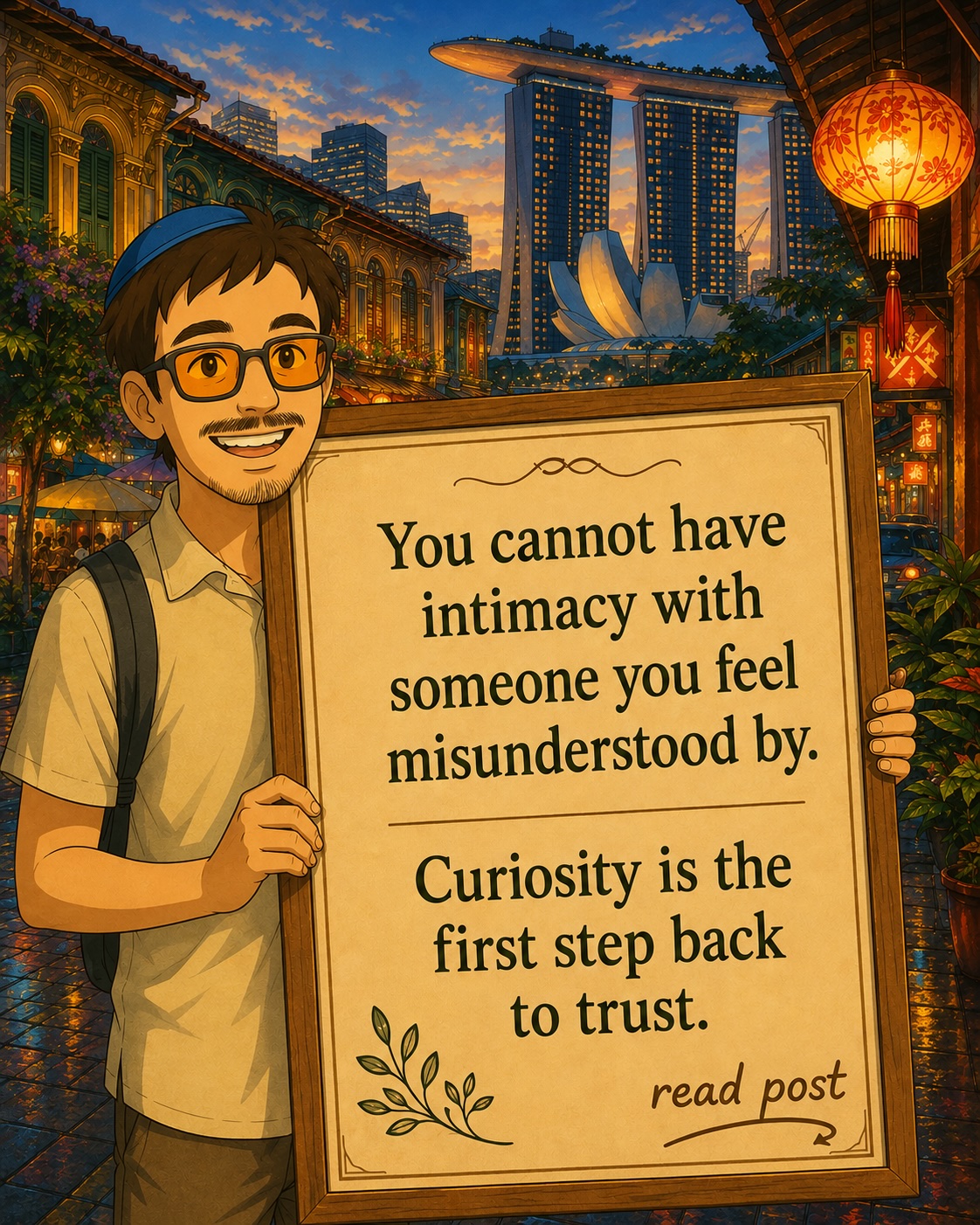
Curiosity is often the first movement out of survival mode.
Survival mode says, “I already know what this means. I am unsafe. I am alone. I have to protect myself.”
Curiosity says, “Maybe there is more goodness here than I can feel right now.”
Sometimes curiosity means wondering “what’s going on?” Action should be based on curiosity, not fear based calculating.
One should keep going back to curiosity through out the day.
That choice matters.
Because you cannot trust someone you are not willing to wonder about.
And you cannot have intimacy with someone you feel misunderstood by.
Increasing trust in The Creator’s goodness does not create The Creator’s goodness.
It reveals more of the goodness that was already there.
When a person feels misunderstood by The Creator, closeness feels unsafe.
But when a person begins to trust that The Creator’s goodness is deeper than their confusion, pain, shame, and fear, relationship becomes more possible.
Not because The Creator changed.
Because the vessel became more able to receive what was always true.
That is the inner structure of trust.
_____________________
What Does It Mean to Trust the Creator Is Good?
Trust does not mean pretending life is easy.
Trust means learning that even concealment can become part of relationship through turning fear into awe.
The shattering created a world where The Creator’s goodness is hidden, and human beings were given the responsibility to reveal it.
Awe is a blend of humility, fear and wonder, life feels more meaningful when you feel awe and the deepest awe is felt through belief in a Creator and trusting He is good.
That is why the deepest question is not only:
“Why is there pain?”
The deeper question is:
“What is my responsibility right now?”
Because creation is not just about receiving goodness.
It is about becoming someone who can recognize goodness, choose goodness, reveal goodness, and live in relationship with The Creator.
When one trusts the Creator is good, love is felt.
As awe, trust, and love deepen, they can allow greater openness and intimacy with the Creator. That intimacy can include sadness when you notice how much more of His goodness can be revealed.
– based on interpretations of talks of the Lubavitcher Rebbe.
Questions people ask
What psychological structure lets a person trust that the Creator is good?
Relationship and responsibility, not control, not blind positivity, and not pretending suffering does not exist. The article turns that structure into emotional skills you practice: humility, honesty, taking responsibility, and staying in relationship even while feeling exposed or dependent. Those skills let goodness feel like closeness instead of overwhelm.
What does the Kabbalah teaching about light and vessels reveal about the origin of ego?
The vessels could not hold all the light the Creator gave, and that gap was not a design flaw; it made room for ego, the sense of “I.” Ego is the personality’s survival response after losing awareness that the Creator is life’s source. The emotional skill of humility lets a person receive goodness without falling into ego.
Why does the article compare extreme people-pleasing to idol worship?
The article quotes Tzvi Hirsch of Nadvorna: extreme people-pleasing can be like idol worship, because an idol puts up with anything and never says no. A person can look gentle or selfless while avoiding the humility of telling the truth. Real humility is the emotional skill of honesty, responsibility, and boundaries, not agreeableness.
What is the difference between curiosity and survival mode thinking?
Survival mode says, “I already know what this means. I am unsafe. I am alone. I have to protect myself.” Curiosity says, “Maybe there is more goodness here than I can feel right now.” Curiosity is the emotional skill that starts moving a person out of survival mode, and the article says to keep returning to it all day.
Explore the NextSelf Blog. Start with this post explaining the world of souls. And my Youtube.
The blog lists all the difference patterns to study, understanding patterns is how one can develop 'Daas' [felt knowing].
Update: As awe, trust, and love deepen, they can allow greater openness and intimacy with the Creator. That intimacy can include sadness when you notice how much more of His goodness can be revealed.