

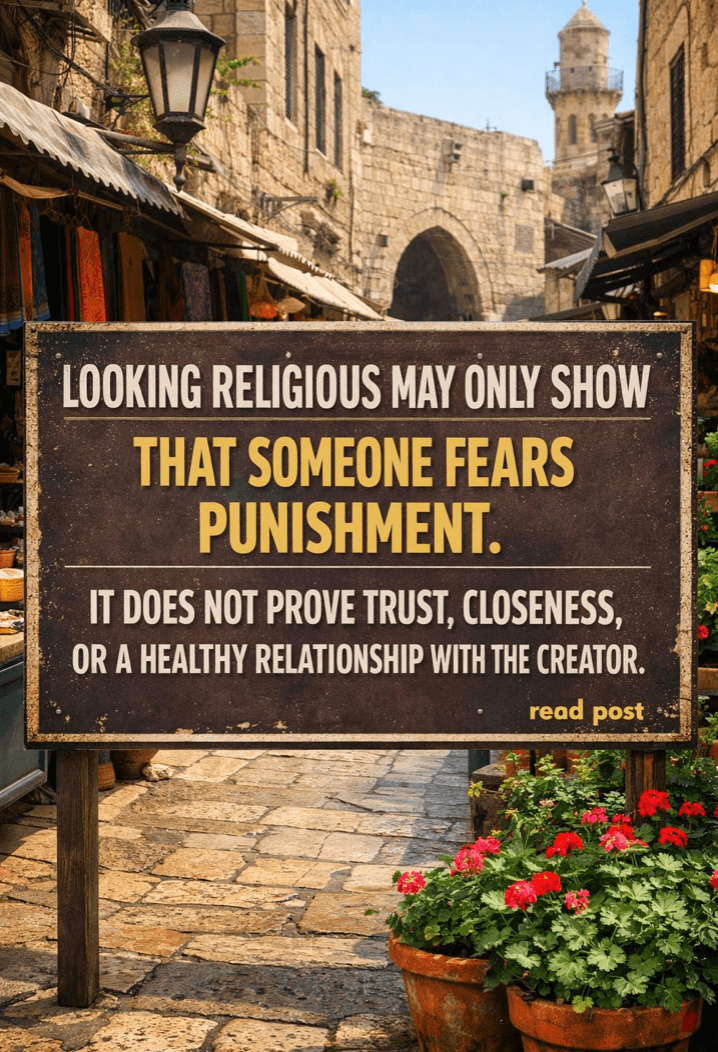
A person can be driven mainly by fear:
Fear of punishment.
Fear of doing something wrong.
Fear of breaking a rule.
Fear of what will happen if they fail.
That fear can make someone careful, strict, and outwardly religious.
But fear alone is not closeness.
---
Sometimes what people call faith is mainly a strong belief that there is reward and punishment.
That is one part of the picture.
But it does not automatically mean the person trusts the Creator's goodness, feels close to Him, or has learned how to bring their emotional life into relationship with Him.
A person can obey while emotionally living as if the Creator is mostly someone to avoid disappointing.
That is very different from intimacy.
---
What is awe, and how is it different from panic?
A relationship with the Creator begins with awe.
Awe is not simply being scared.
It is the felt awareness:
“I am living before the Infinite Creator right now.”
That awareness contains wonder, because His wisdom and the depth of reality are far beyond what you can fully understand.
It contains humility, because you are not the Source, you do not see the whole story, and reality is not under your control.
And it contains healthy fear, because your choices are real and matter.
That is very different from panic about punishment.
Healthy fear says:
“What I do matters.”
Panic says:
“If I make a mistake, I am not safe.”
---
What happens to awe when you trust the Creator is good?
Trust changes the experience of awe.
If you believe the Creator is mainly angry, unpredictable, or looking for reasons to punish you, His greatness can feel threatening.
But when you learn to trust that He is good, awe can become the beginning of intimacy and cause love to be felt.
You can know:
“I do not understand the whole story.”
“I am not in control.”
“My choices matter.”
“And I am living before Someone whose purpose is good.”
That allows you to remain emotionally present in the relationship.
---
How do appreciation, joy, and sadness deepen love?
Then appreciation can deepen both awe and love.
You begin noticing not only Who the Creator is, but the goodness you are receiving from Him.
Awe and love can cause joy because some goodness and closeness are already revealed and you realize life is a gift.
That intimacy can also contain sadness because you want more of that goodness and closeness to be revealed.
You may feel:
“I want to know You more.”
“I want to feel Your closeness more clearly.”
“I want more of Your goodness revealed.”
That sadness can become longing.
And longing is one of the raw ingredients of love.
So sadness is not what creates awe.
Sadness can deepen a relationship that already contains awe and love.
---
Where does responsibility fit into this relationship?
Responsibility matters too.
A healthy relationship with the Creator includes the belief that your choices matter, your inner life matters, and you are responsible for how you treat yourself and other people.
But responsibility is not the same as living in constant fear.
Responsibility means:
“I can choose.”
“I can repair.”
“I can begin again.”
“My actions can reveal more goodness.”
That makes the relationship honest without making it terrifying.
---
Why can a religious person still struggle with intimacy?
This is why someone can be very religious and still struggle with intimacy.
Religion can train behavior.
Intimacy requires more.
It requires enough emotional openness to experience wonder without shutting down, humility without shame, healthy fear without panic, trust without denial, and love without needing everything to feel good.
Looking religious can fool other people.
It can even fool the person themselves.
But being careful is not the same as being close.
Believing that the Creator judges your actions is not the same as trusting His goodness.
And obedience by itself is not the same as relationship.
---
What does real spiritual growth look like?
Real spiritual growth happens when a person does not only obey.
They begin to relate.
They become aware:
“I am living before You.”
They trust:
“Your purpose is good even when I do not understand it.”
They appreciate:
“I notice the goodness already revealed.”
They feel joy:
“I am grateful for the closeness I already have.”
And they can also feel sadness:
“I want more of Your goodness and closeness revealed.”
Love can hold both.
---
Why do emotional skills matter beyond this life?
This matters beyond outward religious behavior.
In the Jewish idea of the world of souls, physical pleasure and physical suffering are no longer the center of experience.
What matters far more is the inner person you have developed.
If someone spent a lifetime unable to tolerate shame, closeness, honesty, awe, or love, simply leaving the physical world does not make those emotional skills meaningless.
And if someone developed awe, trust, compassion, joy, responsibility, and love, those qualities become part of what their soul is able to experience.
So the deeper question is not only:
“How religious did I look?”
It is:
“What kind of inner world am I building?”
Fear can produce religious behavior.
Awe makes you aware of Who you are living before.
Trust lets you remain close.
Love makes you desire His goodness.
And emotional skills make more of your personality able to live inside that relationship.
Looking religious may show that someone takes reward and punishment seriously.
It does not, by itself, prove trust, closeness, awe, love, or a healthy relationship with the Creator.
Questions people ask
Does looking religious mean a person is close to the Creator?
Not automatically. Religion can train behavior, but intimacy requires more. A person can be careful, strict, and outwardly religious while still being driven mainly by fear of punishment. Being careful is not the same as being close, and believing that the Creator judges your actions is not the same as trusting His goodness.
What is the difference between healthy fear and panic?
Healthy fear says, “What I do matters.” It grows out of awe, the felt awareness that you are living before the Infinite Creator right now, together with wonder and humility. Panic says something different: “If I make a mistake, I am not safe.” Healthy fear keeps your choices real; panic makes safety itself feel at risk.
Can someone feel close to the Creator if they believe He is mainly angry or looking to punish them?
Not easily. When someone believes the Creator is mainly angry, unpredictable, or looking for reasons to punish them, His greatness can feel threatening instead of close. That kind of fear is different from awe, which also holds wonder and humility. Learning to trust that He is good is what allows a person to remain emotionally present in the relationship.
Which emotional skills build a real relationship with the Creator?
Awareness of Who you are living before, trust that His purpose is good, appreciation for the goodness already revealed, joy in the closeness you have, feeling sadness safely so it becomes longing, and responsibility for your choices. These emotional skills make more of your personality able to live inside that relationship.
Explore the NextSelf Blog. Start with this post explaining the world of souls. And my Youtube.
The blog lists all the difference patterns to study, understanding patterns is how one can develop 'Daas' [felt knowing].
Update: As awe, trust, and love deepen, they can allow greater openness and intimacy with the Creator. That intimacy can include sadness when you notice how much more of His goodness can be revealed.