

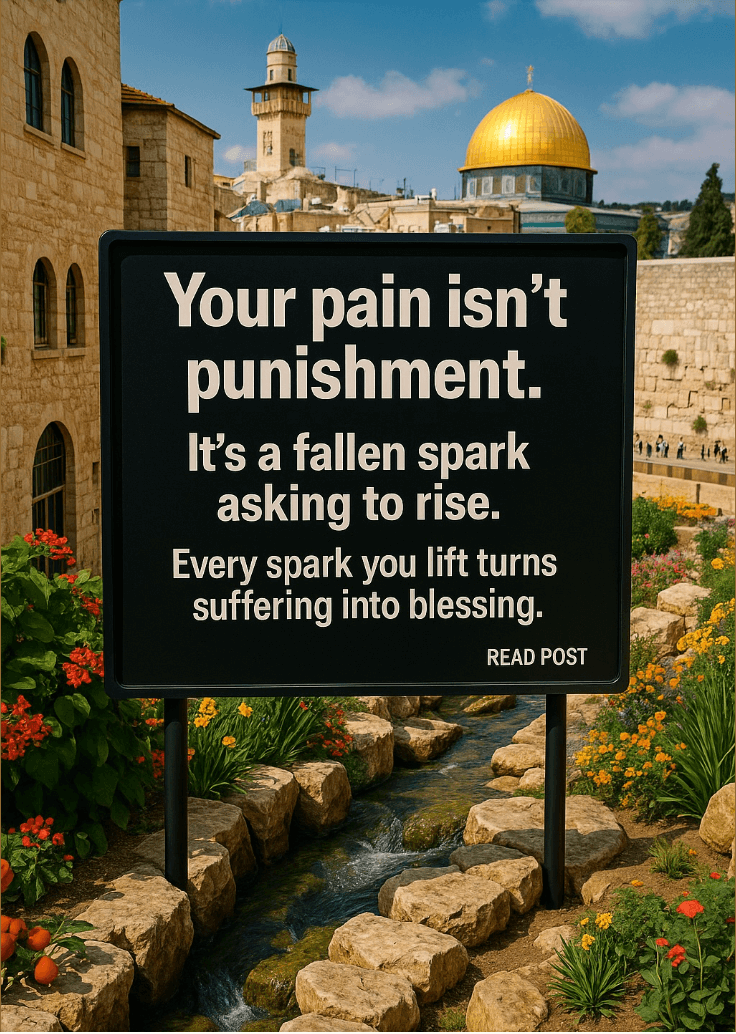
It’s a fallen spark asking you to heal it.
Where does pain come from, according to Kabbalah?
Here’s what Kabbalah teaches: At the beginning, G-d expressed Himself through 10 energies (sefirot). He gave them light (goodness and kindness) anonymously, through concealment, so independence could exist.
Anonymous giving is the purest, an act of unconditional love. But the energies got confused, they thought the light was “their own,” and their effort mattered more than it did.
Ego formed.
And the more ego grew, the farther they felt from G-d. They clung harder to their own effort, not realizing the light was always a gift. The more they grasped, the emptier they felt, until their vessels couldn’t hold the light,
and shattered.
Their light broke into sparks.
How does a fallen spark become pain?
1. Some sparks stayed clear, bringing love and wisdom.
2. Others got stuck inside us, becoming pain (darkness, fallen):
toxic shame, fear, guilt, loneliness, self-blame, confusion.
Examples of fallen sparks from the 10 energies:
Kindness turned into people-pleasing.
Beauty chasing applause → showing off.
Leadership (Malchus) twisted by fear → abusiveness.
Victory chasing wins that never satisfy → addiction.
Gevurah (strength) + Netzach (victory) without compassion → harsh judgment, broken boundaries.
How do fallen sparks show up as trauma patterns?
And there’s another way fallen sparks show up:
Fight → defensiveness, anger, attack.
Flight → avoidance, running from feelings.
Freeze → shutting down, feeling stuck.
Fawn → losing yourself in people-pleasing.
These adaptive trauma patterns are fallen sparks too. They once protected us, but they don’t reflect our true light. Even sin is another way fallen sparks appear. A choice fueled by shame, fear, or craving isn’t your essence, it’s a spark asking for awareness, compassion, and boundaries to rise again.
What can you do when someone hurts you?
When someone hurts you, they’re unknowingly passing along fallen sparks. It feels personal, but it isn’t.
Each time you face your pain with awareness, compassion, and healthy boundaries, energies rooted in Chabad (Chochmah, Binah, Daas), you lift those sparks back into light.
You become a vessel strong enough to hold G-d’s original kindness, the act of unconditional love that began creation.
How did the Jewish people turn suffering into blessing?
This is also the story of the Jewish people.
Through centuries of hate and persecution, nations cast their fallen sparks onto us. Each time we endured, we lifted them, transforming suffering into blessing, not just for us, but for the world.
And here’s the deeper truth:
By studying Chabad Chassidus, you begin to see that every vessel, even the broken ones, is really a channel for that same love.
How can you raise sparks in your own life?
Here’s how you can raise sparks in your own life:
1. Awareness: Notice difficult feelings or patterns, shame, fear, pain, avoidance, people-pleasing. They’re sparks calling for you.
2. Self-compassion: Remind yourself, “These sparks aren’t my fault. I’m trying my best. My pain matters.”
3. Boundaries: Say, “I care, but this behavior isn’t okay.” Protect your vessel.
4. Self-forgiveness: Release the past so the spark can rise.
Pain isn’t only suffering. It’s an invitation. Every spark you lift makes you a stronger vessel for blessing.
Next time pain hits, ask:
“What spark can I raise today?”
Questions people ask
Is my pain a punishment from G-d?
No. Your pain isn’t punishment, and it isn’t random. It’s a fallen spark asking to rise. Pain isn’t only suffering. It’s an invitation. When you meet it with the emotional skills of awareness, self-compassion, healthy boundaries, and self-forgiveness, you lift that spark back into light. Every spark you lift turns suffering into blessing.
What does Kabbalah say about people-pleasing?
Kindness is one of the 10 energies G-d expressed Himself through. People-pleasing is what kindness turns into as a fallen spark. It also shows up as fawn (which is people-pleasing), where you lose yourself. These patterns once protected us, but they don’t reflect our true light. Awareness, compassion, and boundaries are the emotional skills that help the spark rise.
Why does G-d conceal Himself, according to Kabbalah?
Kabbalah teaches that at the beginning, G-d expressed Himself through 10 energies (sefirot). He gave them light, which is goodness and kindness, anonymously, through concealment, so independence could exist. Anonymous giving is the purest, an act of unconditional love. The energies got confused and thought the light was their own, but the light was always a gift.
How do you become a vessel for G-d’s blessing?
The vessels of the 10 energies couldn’t hold the light, and they shattered. Each time you face your pain with awareness, compassion, and healthy boundaries, you lift sparks back into light. You become a vessel strong enough to hold G-d’s original kindness. Boundaries are the emotional skill that protects your vessel, and every spark you lift makes it stronger.
“Your pain isn’t punishment. It’s a fallen spark asking to rise. Every spark you lift turns suffering into blessing.”
Explore the NextSelf Blog. Start with this post explaining the world of souls. And my Youtube.
The blog lists all the difference patterns to study, understanding patterns is how one can develop 'Daas' [felt knowing].
Update: As awe, trust, and love deepen, they can allow greater openness and intimacy with the Creator. That intimacy can include sadness when you notice how much more of His goodness can be revealed.