They are a structure for how a human being stands inside reality.
The Rambam gives the foundation:
Reality has one Creator.
The Creator is not physical.
He does not change.
He alone is worthy of prayer.
Torah is true.
Prophecy is real.
Moshe’s prophecy is unique.
Human choices matter.
There is justice.
The Messiah will come.
The dead will be resurrected for all nations. (Kabbalah)
Chabad Chassidus gives the inner emotional depth of that structure.
It explains that The Creator is beyond all description, yet creates a world where human choices matter.
He does not need anything, yet He desires a dwelling place in the lowest world.
He is not changed by creation, yet creation exists because He chooses goodness, relationship, purpose, and revealed light.
That is what makes the 13 Principles psychologically healthy.
They do not leave the person inside randomness.
They do not make The Creator harsh, needy, emotional, or unsafe.
They do not erase the human self.
They give the personality a place to stand:
before One Infinite Creator,
inside a meaningful world,
with real responsibility, repair, hope,
and a future where hidden goodness becomes revealed.
Without Chassidus, the principles can be misunderstood as cold theology.
With Chassidus, they become a way to live with awe, trust, humility, courage, and emotional responsibility.
The Rambam gives the belief structure.
Chabad Chassidus teaches the soul how to live inside it.
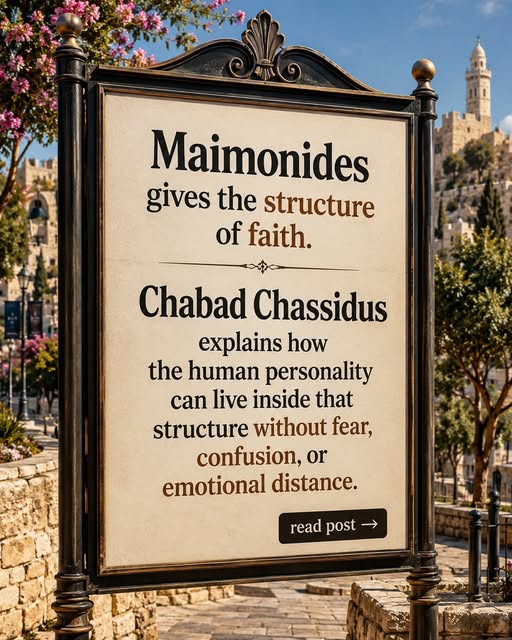
“Maimonides gives the structure of faith. Chabad Chassidus explains how the human personality can live inside that structure without fear, confusion, or emotional distance.”
________________________
Related guides:
Why the Jewish faith is healthier for the nervous system then other belief structure: https://nextself.ai/spirituality/beliefs-are-not-only-an-idea/
Psychology of prayer explained: https://nextself.ai/spirituality/emotional-numbness-is-often-not-emptiness/