

It is what kind of cause makes the most sense.
Some people believe the source of existence is ultimately blind, without intelligence, free choice, or purpose.
Others believe the source of existence is an infinite Creator with intelligence, free choice, and a desire to give goodness.
Neither belief can be proven through logic alone.
The question is which belief better fits the patterns we observe.
And one may explain more of reality than the other.
What do the patterns in the universe point to?
The universe contains wisdom, consciousness, stable patterns, beauty, and human beings who can understand reality and freely choose how to respond to it.
The purpose of noticing patterns is not simply to collect facts.
First, they help us ask what kind of Source makes sense.
Then, as we think about them more deeply, they can change how we experience our relationship with that Source.
We do this every day.
Footprints point to someone who walked there.
Writing points to a mind.
A conversation points to another person.
We do not know everything about the cause before recognizing the kind of cause the patterns point toward.
If intelligence, consciousness, and wisdom are real parts of existence, is it more logical that their source has none of those qualities, or that they come from a Source with intelligence beyond anything the human mind can understand?
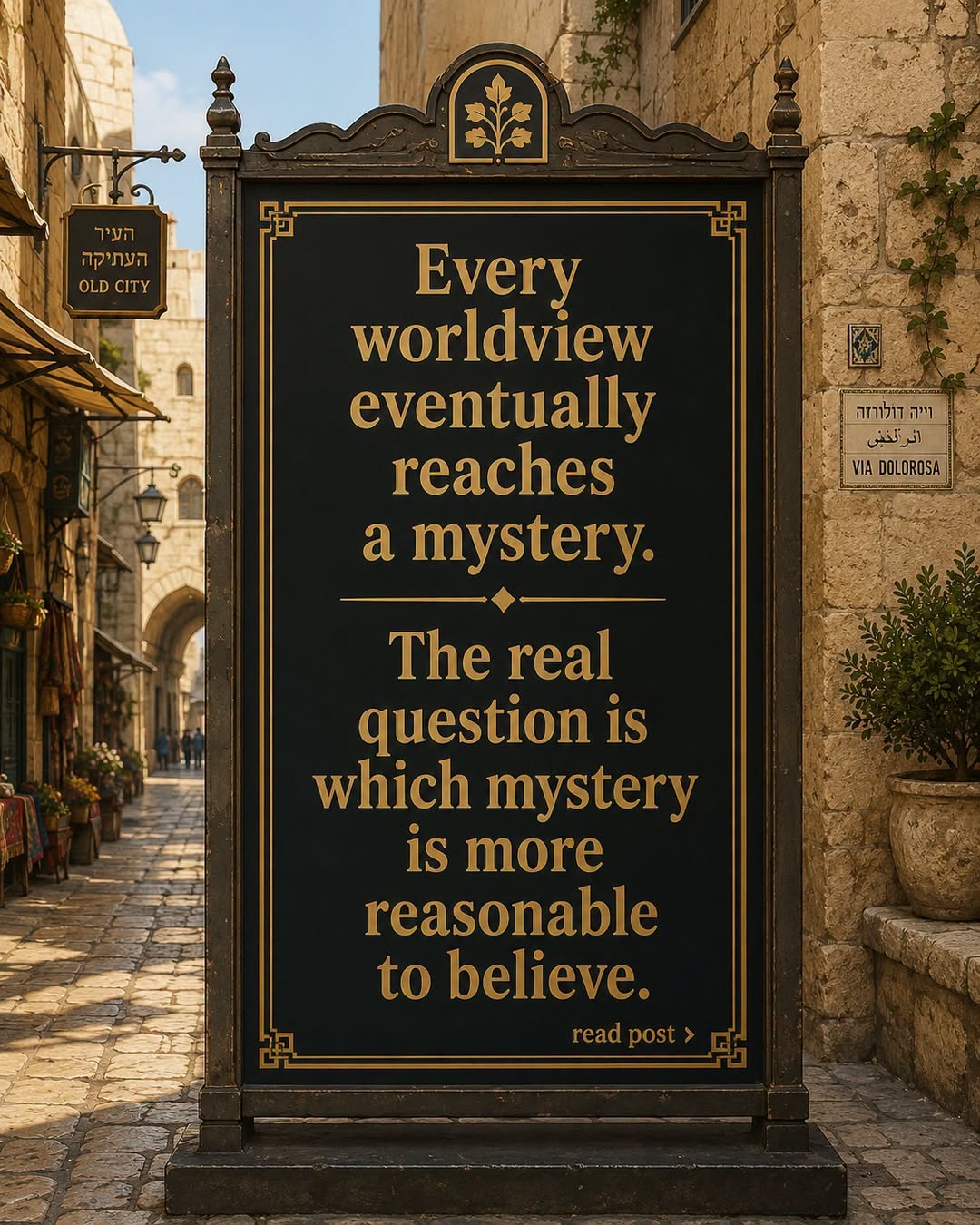
Both beliefs contain mystery, so which is more reasonable?
Every worldview eventually reaches unanswered questions.
The issue is not which one explains everything, but which one better explains the patterns we can already see.
If the cause of existence is blind, then intelligence, consciousness, meaning, and free choice somehow emerged from a source that has none of them.
If the cause is intelligent, then the mystery is how an infinite intelligence exists.
Both beliefs contain mystery.
But it seems more reasonable that wisdom ultimately comes from a Source capable of wisdom than that intelligence emerged from a reality whose deepest nature is completely without intelligence.
__________
How does belief shape the emotional world we live in?
Emotional health does not prove that a belief is true.
But once we ask which worldview better explains the patterns of reality, it is also worth asking what kind of relationship with reality that worldview creates.
What we believe about the Source of existence shapes the emotional world we live inside.
A person who believes reality ultimately comes from a blind cause may experience meaning, love, and goodness as temporary accidents inside an indifferent universe.
A person who believes in an infinite Creator who desires to give goodness can experience life as a gift, relationships as meaningful, and moral choices as part of a greater purpose.
This belief does not mean pretending suffering is good or that every painful event can be easily explained.
It means believing suffering is not the deepest truth about existence.
Goodness is deeper.
Believing the Creator is good also does not remove responsibility.
It means our choices matter because we can either reveal more of His goodness or hide it through fear, cruelty, dishonesty, and control.
A belief is emotionally healthy when it helps a person face reality with greater humility, responsibility, compassion, hope, and healthy boundaries.
Belief in a good Creator can build that kind of inner world.
It tells the nervous system [part of the nervous system has a personality of a 2 year old] that existence is not ultimately meaningless, goodness is not an illusion, and becoming more loving and responsible brings a person closer to the Source of life.
______________
What comes after belief, according to Chabad Chassidus?
According to Chabad Chassidus, belief is only the beginning of a healthy relationship with the Creator.
The relationship becomes more emotionally real when the mind does not only accept that the Creator exists, but repeatedly thinks about what His existence means for this moment.
Curiosity notices patterns of wisdom in life.
Meditation means thinking deeply about those patterns until a person realizes that the Creator is not only the original cause of existence.
He is giving existence to this moment right now.
How does healthy awe begin and awaken love?
The question is no longer only:
“Does the Creator exist?”
It becomes:
“The Infinite Creator is here.”
Healthy awe begins when that idea becomes an awareness of presence:
“I am before the Creator right now.”
A person feels wonder that the Source of all existence is present, humility from standing before Him, and the importance of every choice made in His presence.
Healthy awe naturally awakens love.
When a person begins to feel:
“The Infinite Creator is here,”
they can also begin to feel:
“If He is truly here, I want to be closer.”
If you trust He is good, you can feel love.
Why does intimacy with the Creator contain sadness and joy?
That intimacy can contain sadness because it feels how much of that closeness is still hidden.
The sadness says:
“Your goodness could be more revealed in me.”
“Your presence could be more revealed in the world.”
“I feel close enough to know how much more closeness I desire.”
That sadness is not the opposite of love.
It comes from valuing the relationship enough to feel how much more of it could become revealed.
But intimacy also contains joy.
Why did the seventh Chabad Rebbe stress living with joy?
The sadness feels what is still hidden.
The joy feels what can still become revealed.
It says:
“I can help reveal more of Your goodness.”
This helps explain why the seventh Chabad Rebbe placed so much importance on living with joy while preparing the world for the Messianic era [world peace].
If the Creator’s goodness can become more revealed, then we are not only waiting for a better world.
Our choices can participate in revealing it.
Joy does not mean denying pain or pretending that the world is already complete.
It means living with confidence that darkness is not the final direction of reality, and that every act of honesty, compassion, responsibility, and kindness can reveal more of the Creator’s goodness.
This is where belief becomes a living relationship.
How does belief change the moment you are living in?
Belief in an intelligent and good Creator is not only a philosophical conclusion or a healthier way to understand reality.
It changes how a person experiences the moment they are living in.
Nature, our personality, the people we meet, our struggles, our choices, and our opportunities to do good are no longer experienced as completely separate from the Creator.
Life begins to feel like an ongoing response to Him.
We notice what He is giving us.
We ask what this moment is asking from us.
We choose how to respond.
And we look for how more of His goodness can become revealed through us.
The same patterns that first led us to ask what kind of Source existence comes from eventually teach us something much deeper:
how to relate to that Source.
_________________
Related guides:
People pleasing and misguided awe are like idol worship:
Jewish secret to transform suffering into goodness:
Spirituality is about making your personality better:
How emotional numbness can block spiritual feelings like awe, love and joy:
Emotionally healthy beliefs about the world of souls:
For hundreds of guides to emotionally healthy spirituality: https://www.facebook.com/binyomin.rutstein/photos
Questions people ask
Can you prove the Creator exists through logic alone?
No. Neither belief about the source of existence can be proven through logic alone. The question is which belief better fits the patterns we observe, like wisdom, consciousness, beauty, and free choice. Both beliefs contain mystery. But it seems more reasonable that wisdom ultimately comes from a Source capable of wisdom.
What makes a belief emotionally healthy?
A belief is emotionally healthy when it builds emotional skills. It helps a person face reality with greater humility, responsibility, compassion, hope, and healthy boundaries. Emotional health does not prove that a belief is true. But belief in a good Creator can build that kind of inner world. It tells the nervous system that goodness is not an illusion.
Does believing in a good Creator mean suffering is good?
No. This belief does not mean pretending suffering is good or that every painful event can be easily explained. It means believing suffering is not the deepest truth about existence. Goodness is deeper. Believing the Creator is good also does not remove responsibility, because our choices can either reveal more of His goodness or hide it.
Which emotional skills turn belief into a relationship with the Creator?
According to Chabad Chassidus, belief is only the beginning. The emotional skills practiced here are curiosity and noticing patterns. Curiosity notices patterns of wisdom in life. Meditation means thinking deeply about those patterns until a person realizes the Creator is giving existence to this moment right now. When that idea becomes an awareness of presence, healthy awe begins.
Explore the NextSelf Blog. Start with this post explaining the world of souls. And my Youtube.
The blog lists all the difference patterns to study, understanding patterns is how one can develop 'Daas' [felt knowing].
Update: As awe, trust, and love deepen, they can allow greater openness and intimacy with the Creator. That intimacy can include sadness when you notice how much more of His goodness can be revealed.