

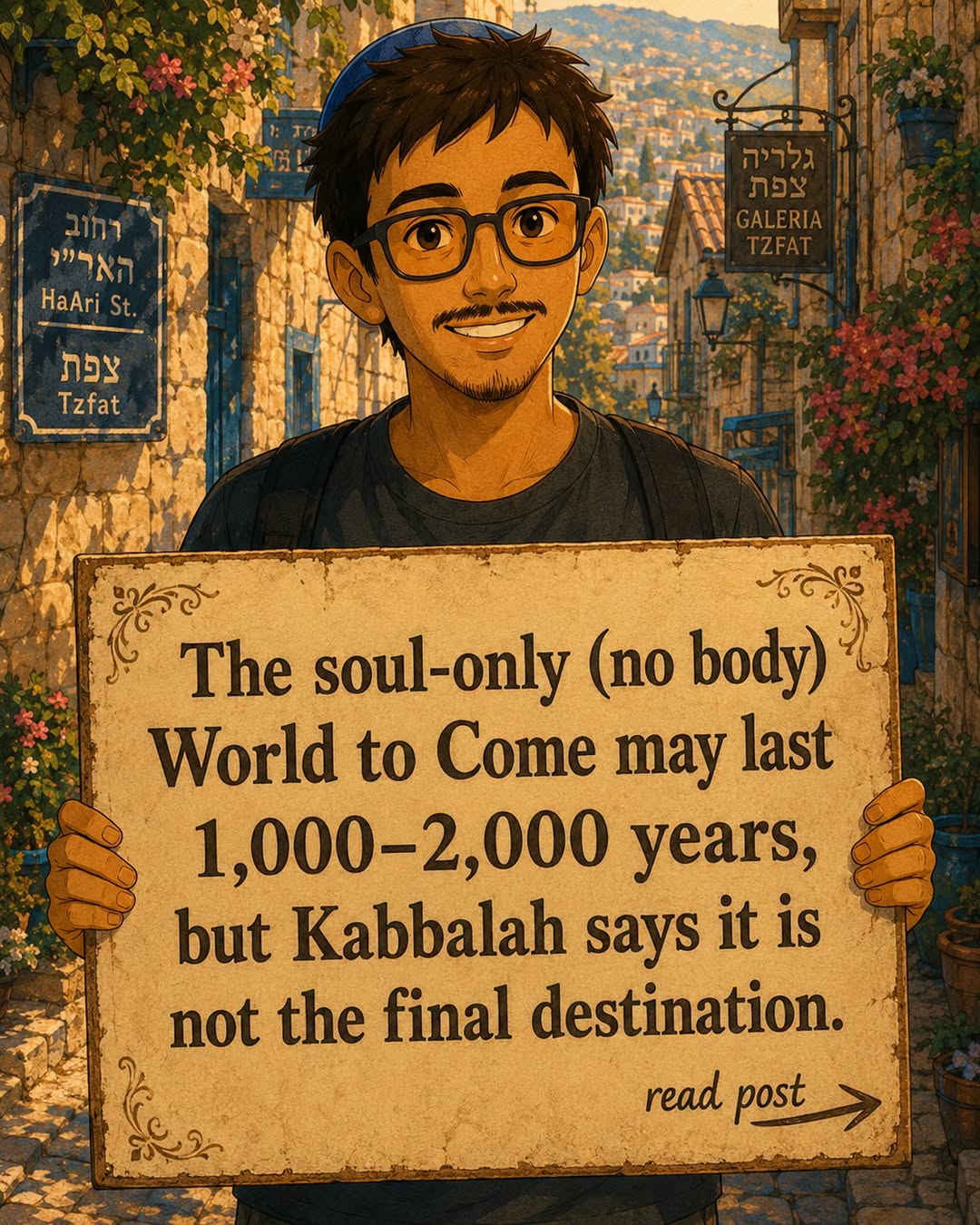
Maimonides [the Rambam] describes the World to Come as fully spiritual.
It comes after the Messianic era, which may last from 1 day to 200+ years, and this spiritual stage of the World to Come takes place in the world of souls. More details about the Messianic era are at the end.
In the world of souls, you remain the same personality, capable of emotion and relationship, but without physical pleasure or physical suffering. Movement happens through thought rather than through a physical body.
“There is even more diversity in the world of souls than in our physical world.” — Rebbe Rashab
Life is about intimacy with the Creator.
What does intimacy with the Creator mean?
Intimacy means two different beings remain different while increasingly knowing each other and freely choosing relationship.
Intimacy does not require need. Something can matter without filling something missing. The Creator does not need creation, but He chose for our relationship with Him to matter [a linked post at the end explains this idea more fully].
That means every moment can become part of a conversation with Him through what you notice, feel, choose, appreciate, ask for, and give.
---
What does every soul thirst for in the world of souls?
In that world, every soul thirsts to know the Creator more.
Accurate interpretations of Torah allow the soul to understand more of what the Creator chose to reveal, feel deeper spiritual emotions, and build deeper relationships with other personalities.
Wisdom deepens awe.
Noticing patterns of immense wisdom, order, beauty, and life can strengthen the awareness:
“The Creator is here, choosing to give existence to every moment.”
Awe comes first.
Awe contains wonder because His wisdom is beyond what we can fully understand, humility because we are limited and do not see the whole story, and healthy fear because our choices matter before Him.
How does trust turn awe into love and intimacy?
But awe by itself is not yet intimacy.
Trust that the Creator is good changes how you relate to that awe.
His greatness does not mean you are unimportant. Your life, choices, and relationship with Him matter.
Trust makes greater openness possible because you do not have to protect yourself from the relationship or hide as much of yourself from Him.
It also allows awe to awaken love.
Love means His goodness matters to you, you appreciate what He gives, and you want greater closeness with Him.
Expressing appreciation strengthens both awe and love because you are not only thinking about His greatness; you are noticing His goodness entering your own life.
As trust and love deepen, openness becomes possible.
You become more willing to bring your fear, shame, gratitude, confusion, desires, failures, questions, and joy into the relationship instead of hiding.
That openness deepens intimacy.
Intimacy means increasingly knowing what the Creator chose to reveal, allowing yourself to be known before Him, and freely choosing relationship with greater honesty.
Why can deeper intimacy hold both joy and sadness?
Deeper intimacy can contain both joy and sadness.
Joy comes from becoming more aware that life is a gift and noticing the goodness and closeness that are already revealed.
Sadness can be felt because that same intimacy makes you more aware of how much of the goodness you love is still hidden from yourself, other people, and the world.
The sadness is therefore not required for intimacy. It is one possible experience of intimacy in a world where much of the Creator’s goodness is still concealed.
That sadness can become a desire to channel more goodness toward yourself and others.
As concealment disappears, intimacy does not become weaker.
It can become deeper while containing less sadness and more joy, because more of the goodness you love is actually revealed.
What does the righteous soul experience?
Feelings are experienced more than 1,000 times stronger in the world of souls, so we cannot imagine its emotional pleasure or pain.
“We can’t imagine the Creator’s humility.” — Rabbi Shlomo Yehuda Be’eri
---
The righteous soul experiences the goodness it became ready to receive by learning how to face shame and live with responsibility in the physical world.
That means learning to live morally instead of being controlled by selfishness, people-pleasing, avoiding difficult conversations, or numbing feelings through habits such as overeating.
The soul is not haunted by regret because during physical life it practiced honesty, responsibility, care, and repair.
It also trusts itself more because it carries the evidence of a lifetime spent making choices, repairing mistakes, and learning how to stay in relationship without hiding.
That self-trust supports openness because the soul has learned that seeing its failures clearly does not require rejecting itself or escaping the relationship.
---
Can a soul that practiced self-hatred still feel joy?
A soul that practiced denial, hate, or self-hatred throughout physical life can still experience awe, joy, and love in the world of souls.
But ongoing guilt, shame, and self-hatred can reduce its ability to receive spiritual pleasure such as joy and wonder.
They can also create loneliness because intimacy requires openness, and openness becomes difficult when a personality does not feel safe enough to be fully seen.
Greater awareness does not automatically give a soul the emotional skills needed to handle what it now understands.
It may see more clearly where it caused harm, where it hid, or where fear controlled its choices. But without enough self-compassion, responsibility, and trust, greater awareness can become guilt, shame, distance, and loneliness instead of greater openness and intimacy.
The deepest repair can only happen when the soul returns to the physical world.
---
What comes after the world of souls?
According to the Arizal and Chassidus, the World to Come is ultimately fulfilled in the physical world through resurrection of the dead for all nations, when the body itself becomes a vessel for G-dliness [healthy giving].
Based on the Talmud, the soul-only stage lasts around 1,000–2,000 years.
Resurrection does not begin at the same time for everyone.
The righteous rise first, while those who lived more selfishly need more time in the world of souls to improve their personality, work through guilt and shame, and become more ready for healthy relationship.
One way to understand the timeline is that the righteous return after around 1,000 years, while everyone else returns over the following 1,000 years.
Many of Maimonides’ teachings were originally published in Judeo-Arabic.
---
What is the Messianic era, and how does it begin?
Related guide: The Messianic era
The Messianic era is an era of world peace whose beginning depends on the Jewish people fully returning to relationship with the Creator: living with awe, learning to trust that He is good, and accepting the leadership and teachings of the “Moses” He sends.
This also helps explain why deeper intimacy in an era of world peace does not require deeper sadness.
In a world where much of the Creator’s goodness is hidden, intimacy can contain sadness because closeness makes the hiddenness more noticeable.
But as His goodness becomes more revealed, the reason for that sadness decreases.
Awe can deepen.
Trust can deepen.
Love can deepen.
Openness can deepen.
And intimacy can deepen while containing more joy and less sadness, because the goodness you are becoming closer to is increasingly visible in the world.
Building trust in the Creator also requires some self-trust because a person has to believe they can make mistakes, repair, and begin again without losing the relationship.
The leader also has to become beloved by the Jewish people because healthy leadership cannot be built only through fear or authority.
The Lubavitcher Rebbe left more than 70,000 published pages of teachings to guide the Jewish people toward a deeper relationship with the Creator and help bring the Messianic era sooner.
A central part of that work is to fully return to relationship with Him, demand more revealed goodness, and develop the mindset:
“I am here to be a channel for goodness toward myself and others.”
__________________
The Talmud says that if the Messiah is among those who have passed away, he would be someone as beloved as Daniel.
The Messiah is also the Nasi HaDor, the leader who continues the role of Moses in his generation, guiding people through his teachings toward belief in the Creator and trust that He is good.
This suggests that a Nasi HaDor can continue to hold that role even after passing away, when his mission and teachings continue to be accepted and guide the generation.
Maimonides explained the only healthy beliefs for the nervous system, healthier then Buddhism/Atheism: Beliefs are not only an idea in your mind
How does suffering help us feel the Creator chose humanity for relationship: The story of Joseph and his brothers helps explain why The Creator chose a human being
Psychology of prayer explained: Emotional numbness is often not emptiness
Humans become co-partners in creation through learning and practicing emotional skills: Humanity becomes a co-partner in creation
How to relate to the Creator in a healthy way: The word “G-d” is a descriptive name
We have 7 types of thoughts: The Chernobyl Maggid teaches that we only have seven types of thoughts
Questions people ask
What is the World to Come according to Maimonides?
Maimonides, the Rambam, describes the World to Come as fully spiritual. It comes after the Messianic era and takes place in the world of souls. According to the Arizal and Chassidus, the World to Come is ultimately fulfilled in the physical world through resurrection of the dead, when the body itself becomes a vessel for G-dliness, meaning healthy giving.
Do souls still feel emotions in the world of souls?
Yes. In the world of souls you remain the same personality, capable of emotion and relationship, but without physical pleasure or physical suffering. Feelings are experienced more than 1,000 times stronger there, so we cannot imagine its emotional pleasure or pain. Accurate interpretations of Torah allow the soul to feel deeper spiritual emotions.
Which emotional skills does a soul need in the world of souls?
Greater awareness does not automatically give a soul the emotional skills to handle what it now understands. The article names self-compassion, responsibility, and trust. They are practiced in physical life through honesty, care, repairing mistakes, and staying in relationship without hiding. With these emotional skills, seeing your failures clearly can lead to openness and intimacy instead of guilt and shame.
How long does the soul-only stage last before resurrection?
Based on the Talmud, the soul-only stage lasts around 1,000 to 2,000 years. Resurrection does not begin at the same time for everyone. One way to understand the timeline is that the righteous return after around 1,000 years. Everyone else returns over the following 1,000 years, because those who lived more selfishly need time to work through guilt and shame.
Explore the NextSelf Blog. Start with this post explaining the world of souls. And my Youtube.
The blog lists all the difference patterns to study, understanding patterns is how one can develop 'Daas' [felt knowing].
Update: As awe, trust, and love deepen, they can allow greater openness and intimacy with the Creator. That intimacy can include sadness when you notice how much more of His goodness can be revealed.