

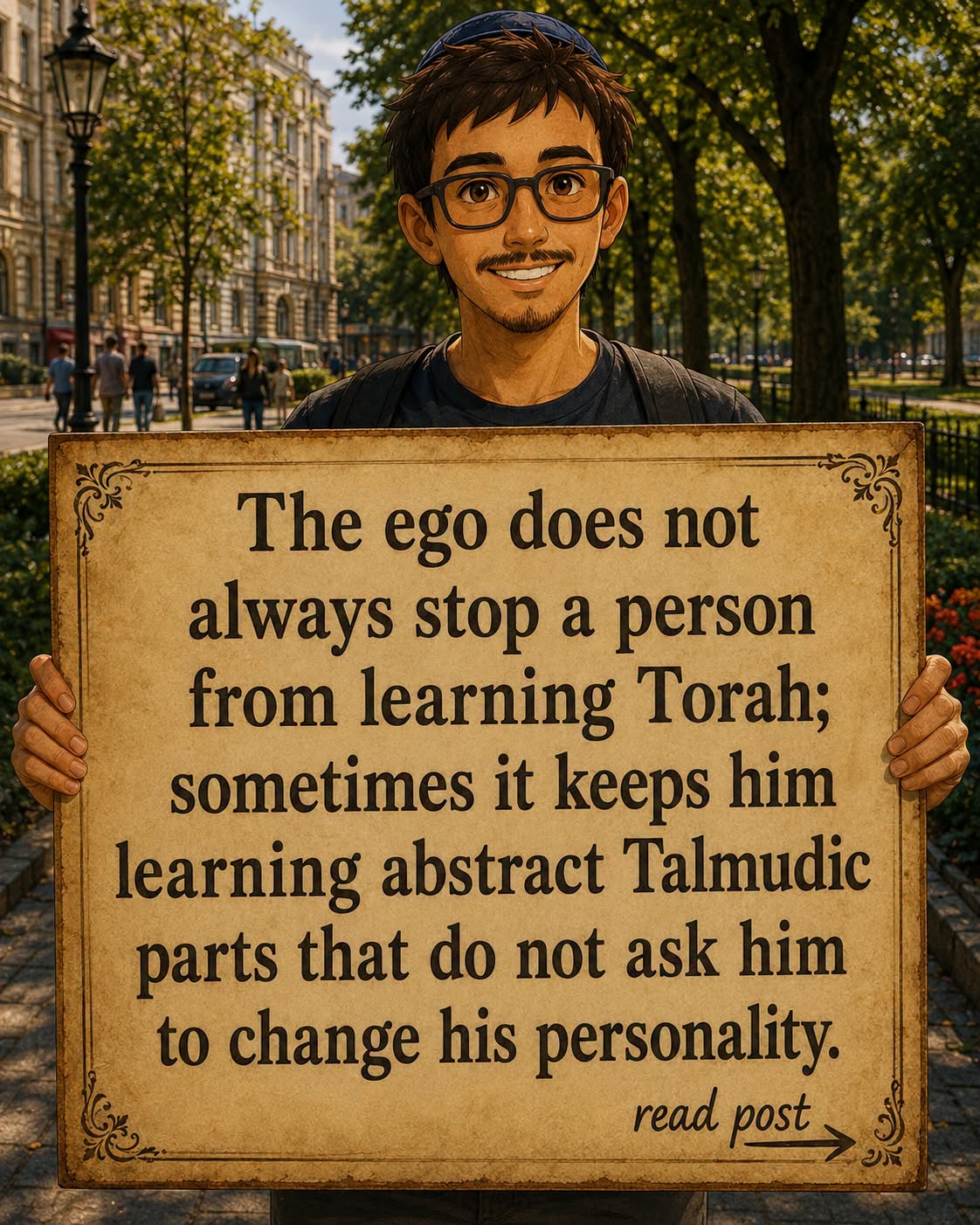
How Does the Ego Quietly Avoid Real Change?
“The ego does not always tell a person to stop learning Torah. Sometimes it encourages the student to restrict his studies to abstract Talmudic subjects and to avoid those books that would inspire change [in personality.]” – Rabbi DovBer of Mezritch commentary on above verse.
The Meiri comments on that verse: “So entrenched is he in his heretical ways that he does not even want to learn the ways of the Torah, which would cause him to better his ways.
#Chayenu app for studying book of psalms by King david.
What Is the Idea, in One Line?
“The ego does not always stop a person from learning Torah; sometimes it keeps him learning abstract Talmudic parts that do not ask him to change his personality.”
____________
Where Can You Read More Like This?
Related guides:
Generational trauma causes awareness/compassion to be replaced with survival thinking like narcissism: Trauma hurts.
Rav Shach misguided 100k+ orthodox jews: Rav Shach z"l misguided more than 100,000 Orthodox Jews about Chabad Chassidus
the source of all wisdom, order, and intelligence cannot be blind in the same way a rock is blind, there are beliefs about the source that are logical and emotionally healthy – Beliefs are not only an idea in your mind
religious narcissism mistakes performance for relationship with the Creator: Religious narcissism
Explore the NextSelf Blog. Start with this post explaining the world of souls. And my Youtube. Content is published to this facebook first and a few days later, to the blog.
The blog lists all the difference patterns to study, understanding patterns is how one can develop 'Daas' [felt knowing].
Update: As awe, trust, and love deepen, they can allow greater openness and intimacy with the Creator. That intimacy can include sadness when you notice how much more of His goodness can be revealed.