

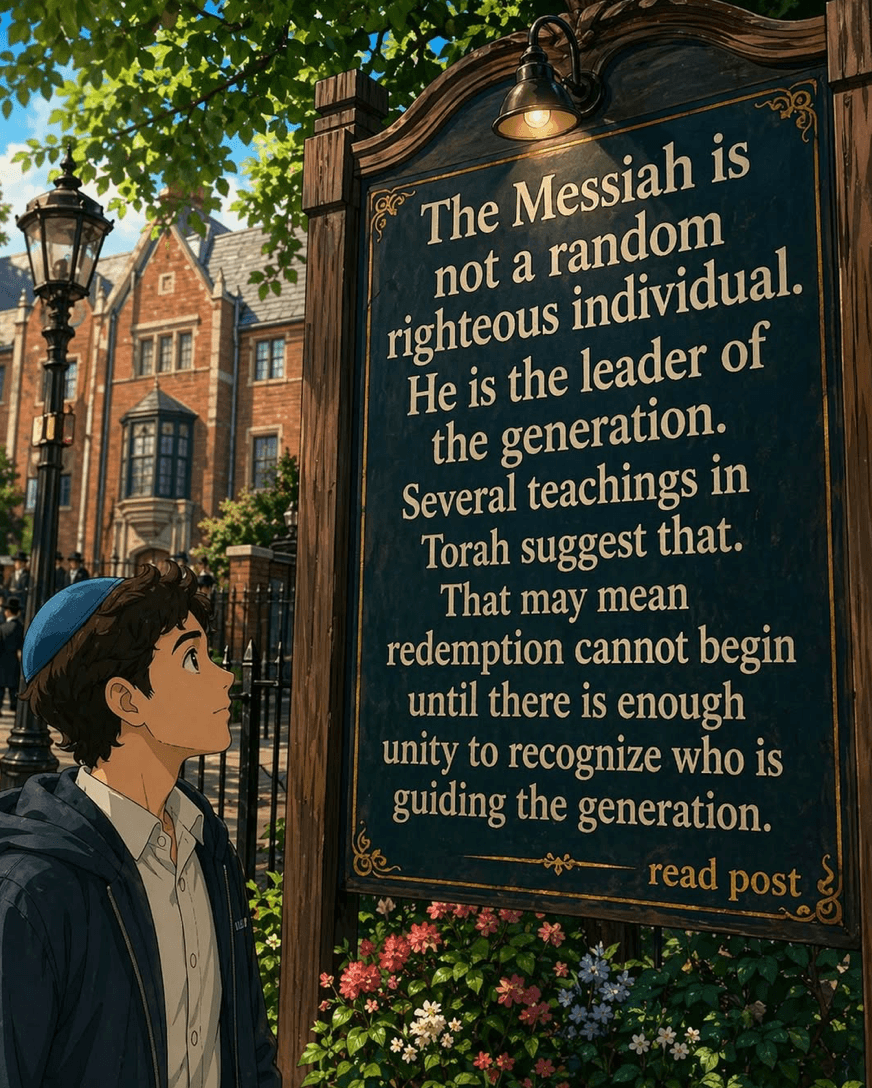
The Messiah is not described in the Talmud as a random righteous individual.
What does the Talmud actually say about the Messiah?
The Talmud says:
“If Moshiach is among the living, he is like Rabbi Yehudah HaNasi. If he is among those who have passed away, he is like Daniel.” Again and again, the person being pointed to is someone guiding the generation.
A king.
A judge.
A national leader.
Someone whose life sits at the center of the generation’s struggle.
The Talmud says King Chizkiyahu could have been the Messiah. Midrash says Jacob saw Shimshon, a national judge, and thought he was the Messiah. Rabbi Akiva identified Bar Kochba as the Messianic king while he was leading the generation.
Why is the Messiah tied to the leader of the generation?
That suggests something important:
The Messiah is not just a private holy person. He is tied to the leader who guides the generation. The one through whom the generation’s direction becomes clear. That is why this discussion does not go away.
If Messiah is connected to the leader of the generation, then redemption is not only about private goodness.
It is also about whether people can recognize who is truly guiding them. And if the person is someone who passed away, that still does not make the question simple.
What if the Messiah already passed away?
The Talmud does not just mention someone from among the dead. It describes Daniel as “the beloved man.”
That means the issue is not only whether someone passed away. It is whether that description still fits him.
How does fear block that recognition?
But that raises another question: If redemption is connected to recognizing who truly guides the generation, what blocks that recognition?
Fear can. And the Midrash Yalkut Shimoni shows how real that fear can become.
It describes world leaders provoking each other, Persia destroying the world, the nations falling into panic, and the Jewish people becoming afraid. And in that exact moment,
The Creator speaks to that fear directly:
“My children, do not be afraid. All that I have done, I have done only for your sake. Why are you afraid? Do not be afraid; the time of your redemption has arrived.”
That means trust in The Creator is not a side point in redemption. It may be part of what makes redemption possible. Chazal also say that most of the Jewish people did not leave Egypt.
What does trust in The Creator look like?
One way to understand that is this:
Redemption needs trust in The Creator and in the leader He sends.
Trust means reminding yourself all the time: I do not need to panic. The Creator will provide in the best way for me. And that trust helps people let go of control, fear, image management, and ego reactions like people pleasing, tantrums or unhealthy avoidance.
And that is what makes real honesty and unity possible. And maybe that unity is what allows the Jewish people to recognize who is truly guiding the generation.
“The Messiah is not random righteous individual. He is the leader of the generation. Several teachings in Torah suggest that. That may mean redemption cannot begin until there is enough unity to recognize who is guiding the generation.”
Questions people ask
Does the Talmud describe the Messiah as a random righteous person?
No. The Talmud says that if Moshiach is among the living he is like Rabbi Yehudah HaNasi, and if he is among those who have passed away he is like Daniel. Again and again the person being pointed to is someone guiding the generation: a king, a judge, a national leader.
Which leaders does the Talmud connect to the Messiah?
The Talmud says King Chizkiyahu could have been the Messiah. Midrash says Jacob saw Shimshon, a national judge, and thought he was the Messiah. Rabbi Akiva identified Bar Kochba as the Messianic king while Bar Kochba was leading the generation. Each of them was guiding the people of his own time.
Why does the Talmud compare the Messiah to Daniel?
The Talmud says that if Moshiach is among those who have passed away, he is like Daniel. The comparison is not just a mention of someone from among the dead. The Talmud describes Daniel as “the beloved man.” So the issue is not only whether the person passed away. It is whether that description still fits him.
What happens before redemption, according to the Midrash Yalkut Shimoni?
The Midrash describes world leaders provoking each other, Persia destroying the world, the nations falling into panic, and the Jewish people becoming afraid. In that exact moment The Creator speaks to that fear and says not to be afraid, because all He has done was done for their sake and the time of redemption has arrived.
“The Messiah is not a random righteous individual. He is the leader of the generation. Several teachings in Torah suggest that. That may mean redemption cannot begin until there is enough unity to recognize who is guiding the generation.”
Explore the NextSelf Blog. Start with this post explaining the world of souls. And my Youtube. Content is published to this facebook first and a few days later, to the blog.
The blog lists all the difference patterns to study, understanding patterns is how one can develop 'Daas' [felt knowing].
Update: As awe, trust, and love deepen, they can allow greater openness and intimacy with the Creator. That intimacy can include sadness when you notice how much more of His goodness can be revealed.