

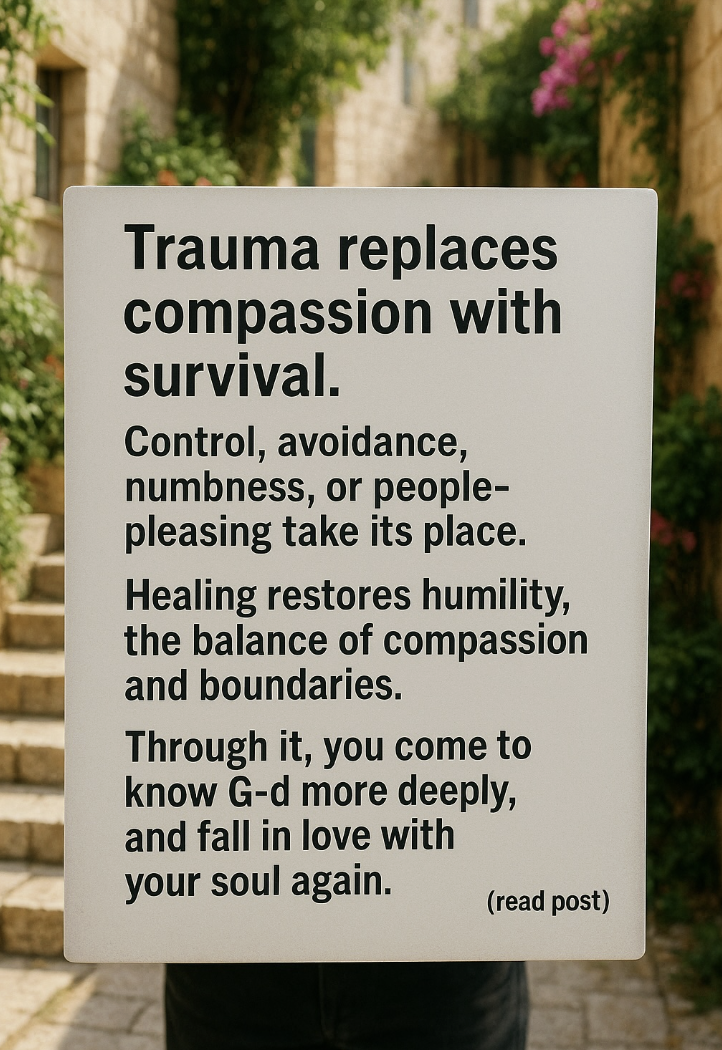
But healing from trauma can teach you things about yourself that you may never have learned otherwise.
You begin meeting parts of yourself you once avoided: the angry part you judged, the fearful part you hid, the numb part that shut down, and the part that learned to please other people to feel safe.
Healing is not one exact routine for everyone.
It can include breathing practices, learning to notice what is happening in your body, eating in healthier ways, moving with more care, developing boundaries, and learning to treat both your past self and present self with compassion.
It can also mean facing a deeper question:
“Do I still believe I am living inside a reality created for goodness, even when I cannot understand what is happening?”
That question matters.
If suffering feels completely meaningless, your nervous system has a strong reason to avoid looking at it.
But when you believe there is a deeper purpose that you cannot fully see yet, you can have more strength to face what hurts, learn from it, and decide how you want to respond.
---
Why do old survival patterns still control your relationships?
Trauma often pushes the nervous system into survival.
In the original situation, fighting, running away, shutting down, or complying may have been intelligent ways to get through something overwhelming.
The problem is when those strategies keep controlling your relationships after the danger is gone.
Fight (which often shows up as narcissism) can replace compassion with control: “I have to overpower this person before they hurt me.”
Flight (which is avoidance) can replace curiosity with avoidance: staying constantly busy, distracting yourself, or escaping into food, work, or other habits so you do not have to face uncomfortable feelings and beliefs.
Freeze (which looks like inaction or shutdown) can replace connection with numbness: “I don't know what I feel,” “I have to deal with this alone,” or “There is no point trying.”
Fawn (which is people-pleasing) can replace honesty with people-pleasing: giving people what you think they want while hiding what you actually feel or need.
Healing helps the strengths hidden inside those patterns become healthier.
Fight can become courage and boundaries.
Flight can become determination and focused action.
Freeze can become awareness and patience.
Fawn (which is people-pleasing) can become compassion, fairness, and genuine care.
---
Why does humility need both compassion and boundaries?
This is where humility becomes important.
Humility is not thinking less of yourself.
It is recognizing your limits while still knowing that your needs, choices, and responsibilities matter.
Practically, humility requires both compassion and boundaries: enough compassion to care about another person, and enough boundaries to remain honest about yourself.
As your nervous system becomes less controlled by survival, you can become more emotionally available to reality.
And that can deepen spirituality.
---
How does healing make awe possible?
You may have intellectually believed in the Creator for years while much of your nervous system still lived as though you were alone, unsafe, or responsible for controlling everything.
Healing can make more of your personality able to notice:
“I am living before the Creator right now.”
That is where awe begins.
Awe contains wonder because His wisdom and the depth of reality are far beyond what you can fully understand.
It contains humility because you are not the Source, you do not see the whole story, and you cannot control reality.
And it contains healthy fear because your choices are real and matter.
Healing does not create awe, but it can make more of your nervous system able to experience it.
---
Can joy and sadness both deepen closeness with the Creator?
Then compassion and appreciation can cause love.
As you learn to care for your own soul, you can become more able to recognize the goodness you are receiving from the Creator.
That intimacy can contain joy because some goodness and closeness are already revealed.
And it can contain sadness because you want more healing, more closeness, and more goodness to be revealed.
That sadness can become longing that leads to channeling more goodness to yourself and others.
You can feel:
“I want to know You more.”
“I want to feel Your goodness more clearly.”
“I want more goodness revealed through the way I live.”
Sadness can deepen awe too, because it can make you look more carefully at the Creator, His purpose, and what your choices can help reveal.
So intimacy does not require choosing between joy and sadness.
Joy appreciates the goodness already revealed.
Sadness longs for more goodness to be revealed.
Both can deepen the relationship.
---
Why is healing not separate from spirituality?
This is why healing is not separate from spirituality.
Every time you replace control with compassion, avoidance with awareness, numbness with honest feeling, or people-pleasing with compassionate boundaries, more of your personality becomes able to live in relationship.
You do not come to know the Creator simply by feeling more emotions.
You come to know Him more deeply when more of your personality becomes able to experience wonder, humility, healthy fear, trust, appreciation, joy, sadness, and longing without needing to shut down.
Healing changes what your nervous system is able to notice.
And that can deepen both awe and love.
_____________
Related guides:
The jewish secret to transform suffering into blessing, explained: Your pain isn't random
Questions people ask
What can healing from trauma teach you about yourself?
Healing can teach you things about yourself that you may never have learned otherwise. You start meeting parts you once avoided: the angry part, the fearful part, the numb part, and the part that learned to please others to feel safe. The emotional skills being practiced are awareness and self-compassion toward your past and present self.
What happens to fight, flight, freeze, and fawn after healing?
Healing helps the strengths hidden inside those patterns become healthier. Fight can become courage and boundaries. Flight can become determination and focused action. Freeze can become awareness and patience. Fawn (which is people-pleasing) can become compassion, fairness, and genuine care. Those are emotional skills: boundaries, focused action, patience, and fair compassion.
Why does healing from trauma deepen spirituality?
As your nervous system becomes less controlled by survival, you become more emotionally available to reality. Healing does not create awe, but it can make more of your personality able to notice that you are living before the Creator right now. The emotional skills here are humility and honest boundaries.
Is it normal to feel both joy and sadness about your relationship with the Creator at the same time?
Yes. Intimacy does not require choosing between them. Joy appreciates the goodness already revealed, and sadness longs for more goodness, more healing, and more closeness to be revealed. That sadness can become longing that channels more goodness to yourself and others, so feeling sadness safely is itself an emotional skill.
Explore the NextSelf Blog. Start with this post explaining the world of souls. And my Youtube.
The blog lists all the difference patterns to study, understanding patterns is how one can develop 'Daas' [felt knowing].
Update: As awe, trust, and love deepen, they can allow greater openness and intimacy with the Creator. That intimacy can include sadness when you notice how much more of His goodness can be revealed.