
But it also teaches.
When life breaks you, you face parts of yourself you once avoided: the angry part you judged, the fearful part you hid, and the wounded parts you did not know how to love.
Healing is not one exact routine for every person. It may include breath work, learning to be with your body, eating in a healthier way, moving with more care, and accepting both your past self and your present self.
It also means asking yourself, “Am I still loved?”
If you can answer yes, it means you believe there is a greater goodness happening, even when you do not see the full picture. It means suffering can hold deeper meaning, and that deeper meaning can allow greater healing to happen.
The more compassion you show yourself, the more emotionally available you can become. That emotional availability awakens awe, a deep yearning to feel close to G-d, and a love toward your own soul.
Awe is a blend of sadness, fear, and wonder.
Sadness because His goodness can always be more revealed.
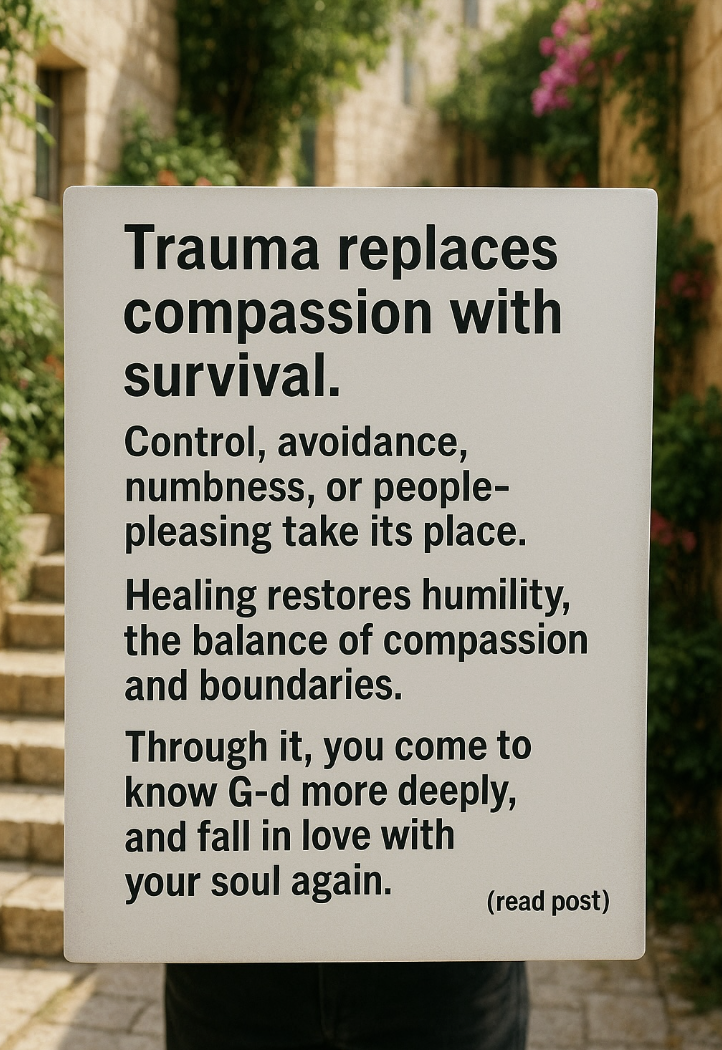
When there is trauma, we are fully focused on surviving. In the moment, the strategies we use, like running away, going numb, controlling, or complying, can be intelligent ways to get through the experience.
But the system can get stuck in those strategies.
- Fight replaces compassion with control — trying to protect through power or aggression. Another form is telling yourself, “He is being tricky,” “She wants me to be gullible,” or “They don’t appreciate me.”
- Flight replaces compassion with avoidance — staying busy with work, food, or addiction to escape feeling and to avoid curiosity about your beliefs and thoughts.
- Freeze replaces compassion with disconnection — going numb to stay safe and telling yourself, “I don’t even have words to describe how I feel,” “I have to do this alone,” or “It’s pointless.”
- Fawn replaces compassion with people-pleasing — trading authenticity and honesty for acceptance. When you keep score in your mind, it is not kindness; it is manipulation.
These patterns are the opposites of humility.
Humility is not weakness. It is balance: the meeting point of compassion and boundaries. It is the strength to care deeply without losing yourself.
When trauma teaches your system to choose control, avoidance, numbness, or people-pleasing, it blocks the humility that lets compassion flow freely.
That’s a secret:
Unconditional love is not only something you study. It is something you live through the way you relate to yourself.
It is the return from survival to presence.
Through healing, you can come to know G-d in a way you never could without healing. Because G-d contains unconditional love itself, and through every act of compassion, you begin to understand His love more deeply and fall in love with your soul again.
_____________
Related guides:
The jewish secret to transform suffering into blessing, explained: https://nextself.ai/spirituality/your-pain-isnt-random/
If you want to go deeper into this work, explore the NextSelf 2026 and 2025 Indexes.
It organizes the core ideas on awareness, compassion, boundaries, and how they build real relationship and responsibility with The Creator.


