

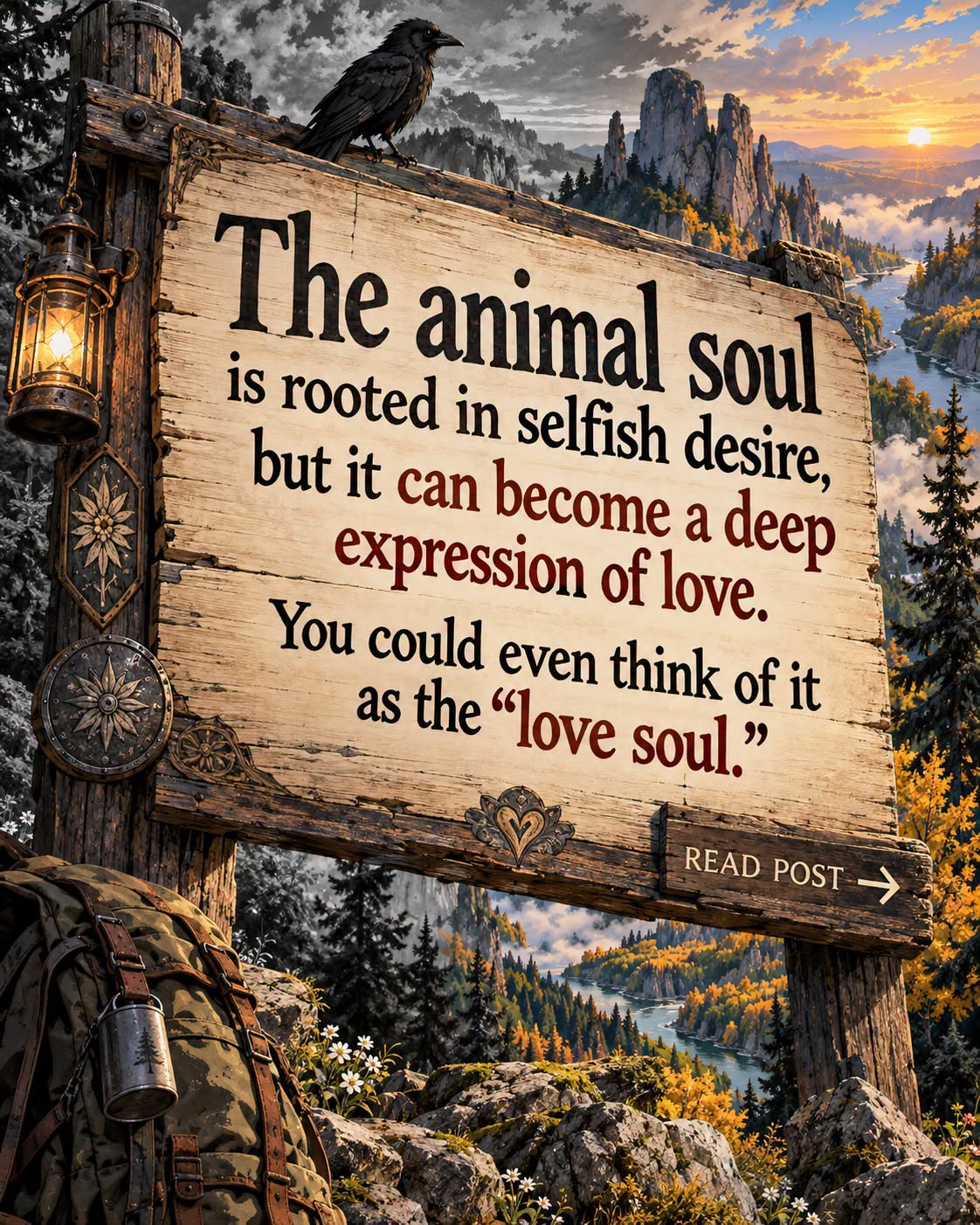
Love can begin in selfish desire and still become something much deeper.
In Chassidus, the animal soul is rooted in selfish desire.
It naturally asks:
“What do I want?”
“What feels good to me?”
“What makes me feel safe, loved, respected, or connected?”
That does not mean the animal soul is evil.
It means its natural starting point is the self.
Why call the animal soul the “soul of love”?
In that sense, you could even describe the animal soul as the “soul of love.”
Not because its love is automatically selfless, but because it is the part of the human personality that wants, attaches, enjoys closeness, and can grow into a deep expression of love.
Love can begin there:
“I want you because being close to you feels good.”
“I care about you because your love gives me pleasure.”
Animals also form bonds, seek closeness, protect each other, and care for their young. Physical life naturally includes desire, attachment, and affection.
Can selfish desire grow into something deeper?
But the animal soul does not have to stay trapped in selfish desire.
It can become a deep expression of love.
Desire can grow into care.
Care can grow into responsibility.
It can even grow into compassion.
Instead of only asking:
“What am I getting from this relationship?”
you begin asking:
“What is my responsibility toward this person?”
You can still enjoy affection, closeness, and pleasure.
But those desires can become part of a deeper love instead of controlling the relationship.
Which emotional skills can the animal soul learn?
The animal soul can learn:
“I want your wellbeing too.”
“I want to treat you well even when I am upset.”
“I am willing to take responsibility for how my choices affect you.”
“I can choose what is good even when another desire is pulling me somewhere else.”
That is still the animal soul, but now its selfish desire has been refined into a deeper expression of love, compassion, responsibility, and free choice.
What does the G-dly soul add to love?
The G-dly soul allows the human personality to express these qualities at an even deeper level.
Its compassion can go beyond what the self naturally wants or receives.
Its free choice can become less about satisfying desire and more about choosing goodness because you want to express something deeper than desire.
So the difference is not that one soul can love and the other cannot.
Both can express love, compassion, responsibility, and free choice.
The G-dly soul allows those qualities to come from a deeper place.
Is the goal to destroy selfish desire?
So the goal is not to destroy selfish desire.
It is to train selfish desire until even the animal soul, the “love soul,” becomes a deep expression of love, compassion, care, and responsibility.
Love can begin with:
“I want you.”
It can grow into:
“I care about what is good for you.”
And through free choice, it can become:
“I choose to take responsibility for how I love you.”
That is where love moves toward real intimacy.
____________________
Related guides:
What does it mean creation is an act of free choice and compassion of the Creator? https://www.facebook.com/share/p/1CtMP5XS86/
#NextSelf #chassidus #kabbalah #spiritualgrowth
“The animal soul is rooted in selfish desire, but it can become a deep expression of love. You could even think of it as the “love soul.””
Explore the NextSelf Blog. Start with this post explaining the world of souls. And my Youtube. Content is published to this facebook first and a few days later, to the blog.
The blog lists all the difference patterns to study, understanding patterns is how one can develop 'Daas' [felt knowing].
Update: As awe, trust, and love deepen, they can allow greater openness and intimacy with the Creator. That intimacy can include sadness when you notice how much more of His goodness can be revealed.