
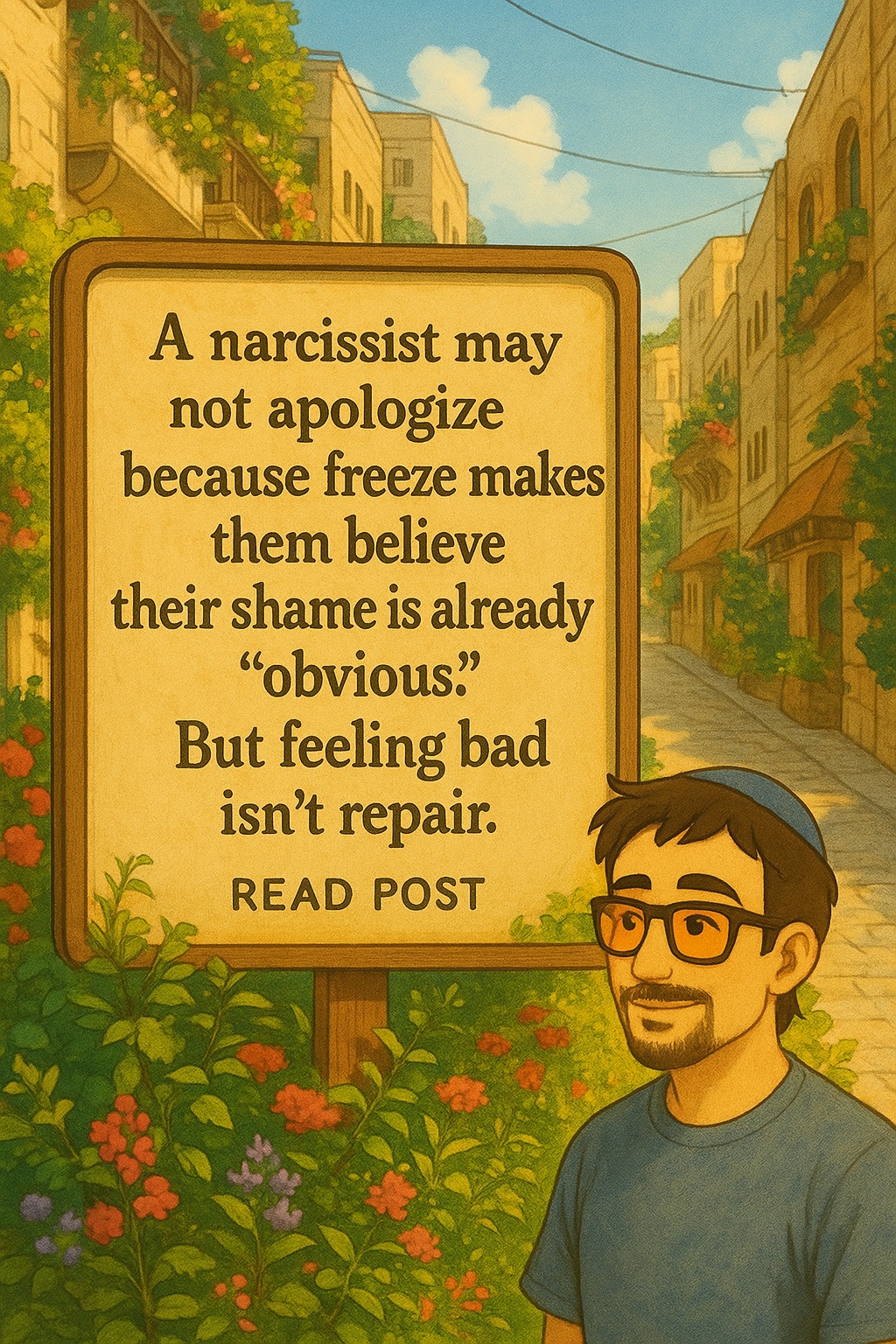
not because they “don’t care,”
but because their nervous system goes into freeze.
Freeze collapses them into shame and they think,
“I feel terrible — isn’t that obvious?”
They confuse their internal pain
with the actual work of repair,
taking responsibility, acknowledging the impact, and making things right.
That’s what relational accountability really means.
But feeling bad isn’t an apology.
It’s the beginning, not the responsibility.
Compassion helps you understand the freeze.
Boundaries remind you that you still deserve real repair,
words, actions, and change.
More guides:
Trauma takes away your awareness: https://nextself.ai/spirituality/from-what-we-know-about-trauma-today/
Why did G-d give Adam 6 laws? https://nextself.ai/spirituality/the-7-noahide-laws/
The Rebbe revealed what Moses concealed: https://nextself.ai/spirituality/why-moses-hit-the-rock/
The gift of being misguided: https://nextself.ai/spirituality/whats-the-benefit-of-being-misguided/
How G-dliness spreads around the world through joy: https://nextself.ai/spirituality/before-joy-comes-awareness/
why is it hard to change unhealthy beliefs? https://nextself.ai/spirituality/ever-wonder-why-its-so-hard-to-leave-a-dysfunctional-system/
People pleasing is like idol worship: https://nextself.ai/spirituality/when-a-part-of-a-personality-doesnt-know-g-d/
If you want to go deeper into this work, explore the NextSelf 2026 and 2025 Indexes.
It organizes the core ideas on awareness, compassion, boundaries, and how they build real relationship and responsibility with The Creator.


