

And before awareness, there must be safety.
When parts of the nervous system are still trapped in old trauma patterns, like:
fight (narcissism),
flight (avoidance),
freeze (rumination),
or fawn (which is people-pleasing)
It doesn’t stop you from noticing kindness, but it limits how much kindness you can take in. It’s too busy scanning for danger to feel safe receiving love.
How Does Awareness Come Back After Trauma?
That’s why healing starts with breath work, compassion, and boundaries, practices that teach the body it’s safe to live again.
As the body relaxes, awareness returns. You begin to notice G-d’s kindness in small moments, the air that fills your lungs, the person who shows care, the second chances that appear in ordinary days.
That awareness becomes gratitude, and gratitude blossoms into joy.
What Does Joy Do Once It Returns?
Joy isn’t escape or denial; it’s what happens when the body finally trusts G-d’s unconditional love again. And once you feel that, it naturally moves outward. Joy turns awareness into acts of kindness, and gratitude into justice.
It’s what gives energy to acts of goodness, helping, forgiving, giving, the moments when G-dliness becomes visible in the world.
Forgiveness is about realizing G-d is in control. You can forgive and still feel angry, anger just means you want change like G-d’s revealed kindness and justice right now.
Why Does Joy Bring the Messiah?
That’s why the Lubavitcher Rebbe taught we will bring Messiah through joy. Because joy breaks boundaries. It dissolves the walls that say, “I’m not enough,” and invites everyone — not just the righteous, to be part of redemption.
Joy is how G-d’s light (giving) spreads, through healed bodies doing acts of goodness and kindness, until the whole world begins to remember what love feels like.
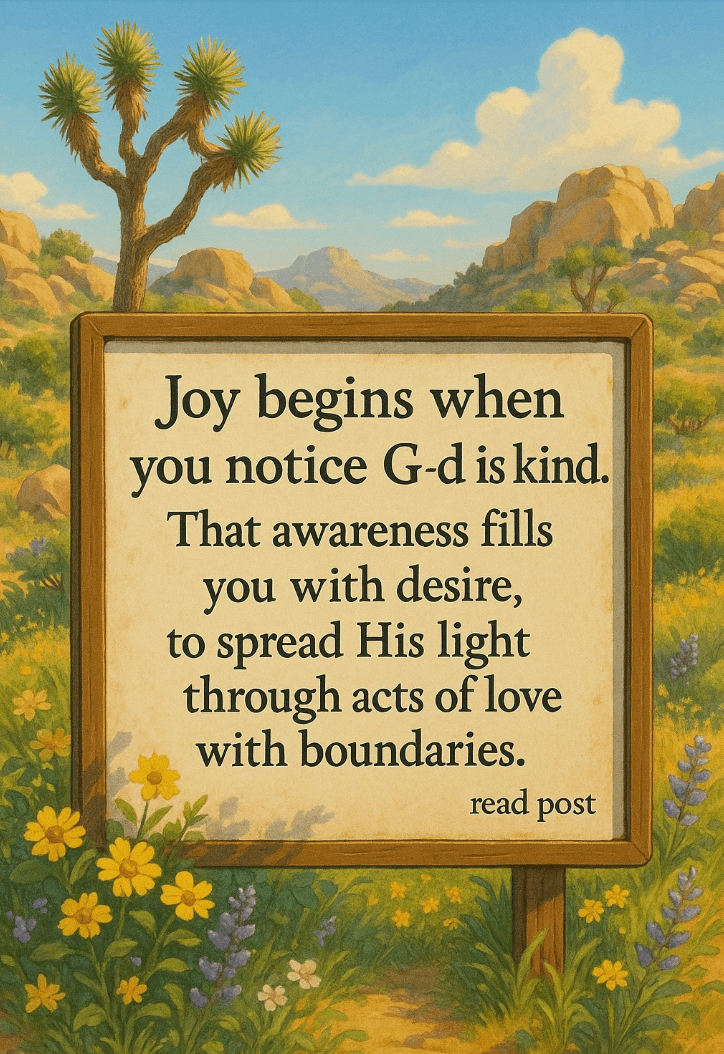
“Joy begins when you notice G-d is kind. That awareness fills you with desire, to spread His light through acts of love with boundaries.”
Nervous system stuck in trauma explained: Abusive Thinking Doesn’t Appear Out of Nowhere
Jewish secret to transform suffering into blessing: Your Pain Isn’t Random
your soul is always pure – Your Soul Never Gets Dirty
People pleasing is depression with a smile – People-Pleasing Isn’t Kindness
Questions people ask
Why is it hard to feel joy when you’re stuck in a trauma pattern?
When parts of the nervous system are still trapped in trauma, like fight (narcissism), flight (avoidance), freeze (rumination), or fawn (which is people-pleasing), they stay busy scanning for danger. That does not stop you from noticing kindness, but it limits how much you can take in. Naming your own pattern is the emotional skill of awareness.
What helps the body feel safe again after trauma?
The article says healing starts with breath work, compassion, and boundaries, practices that teach the body it is safe to live again. As the body relaxes, awareness returns, and you begin noticing G-d’s kindness in small moments, like the air that fills your lungs. That is the emotional skill of self-compassion.
How does awareness turn into joy, according to the article?
The article traces a simple chain: as the body relaxes, awareness returns, that awareness becomes gratitude, and gratitude blossoms into joy. Joy is not escape or denial. It is what happens when the body finally trusts G-d’s unconditional love again, and it naturally moves outward into acts of kindness and justice.
Why did the Lubavitcher Rebbe say joy will bring the Messiah?
The article explains that joy breaks boundaries. It dissolves the walls that say, “I’m not enough,” and invites everyone, not just the righteous, to be part of redemption. That is why the Rebbe taught that joy is how G-d’s light spreads, through healed people doing acts of goodness and kindness.
Explore the NextSelf Blog. Start with this post explaining the world of souls. And my Youtube. Content is published to this facebook first and a few days later, to the blog.
The blog lists all the difference patterns to study, understanding patterns is how one can develop 'Daas' [felt knowing].
Update: As awe, trust, and love deepen, they can allow greater openness and intimacy with the Creator. That intimacy can include sadness when you notice how much more of His goodness can be revealed.