

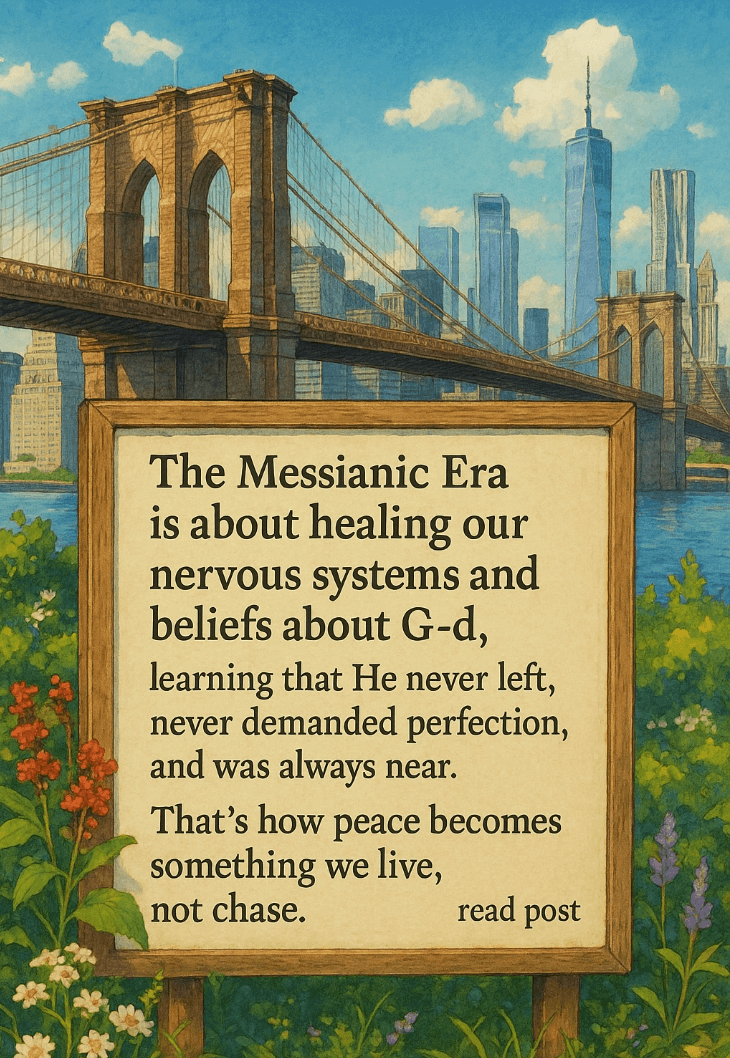
The Messianic Era is the time when creation begins to heal, when humanity learns to repair the nervous system patterns that keep us reactive.
What Do Fight, Flight, Freeze, and Fawn Believe About G-d?
These patterns — fight, flight, freeze, and fawn (people pleasing), each carry a belief about G-d that shapes how we feel safe:
1. Fight believes G-d won’t protect me, so I must stay in control.
2. Flight believes G-d withdraws when I slow down, so I must stay busy.
3. Freeze believes G-d is distant, so I should shut down emotionally to survive.
4. Fawn believes G-d’s love must be earned, so I must please to be safe.
How Does Healing Change These Beliefs?
Healing means the body slowly learns a new truth:
that G-d is constant, kind, and near, even when we stop fighting, avoiding, freezing, or pleasing.
What Does This Peace Feel Like in the World to Come?
That’s the peace we begin to taste in the Messianic Era. And in the World to Come, that peace becomes complete, we will feel joy without shame, earned through love, boundaries, awareness and forgiveness.
a relationship with G-d isn’t complicated:
A relationship with G-d isn't complicated
Jewish secret to transform suffering into blessing:
You can forgive and still feel angry –
Many people misunderstand forgiveness,
Many people misunderstand forgiveness

Questions people ask
What do fight, flight, freeze, and fawn have to do with G-d?
The article says all four patterns carry a hidden belief about G-d. Fight believes G-d won't protect you, so you must stay in control. Flight believes G-d pulls away when you slow down. Freeze believes G-d feels distant. Fawn, which is people-pleasing, believes G-d's love must be earned before you feel safe.
What does healing from these trauma patterns actually change?
The article says healing means the body slowly learns a new truth: that G-d is constant, kind, and near, even when you stop fighting, avoiding, freezing, or people-pleasing. That steady, kind G-d is exactly what fight, flight, freeze, and fawn each struggled to believe was true.
What is the difference between the Messianic Era and the World to Come?
The article says the Messianic Era is when this peace is first tasted, as creation begins to heal and humanity learns to repair the four reactive patterns. In the World to Come, that same peace becomes complete: joy without shame, earned through love, boundaries, awareness, and forgiveness.
Why does the fawn response tie people-pleasing to G-d?
The article says fawn, which is people-pleasing, comes from a belief that G-d's love must be earned, so pleasing others feels like the only way to stay safe. Healing means learning that G-d's love and closeness do not have to be earned. G-d is already constant, kind, and near.
Explore the NextSelf Blog. Start with this post explaining the world of souls. And my Youtube. Content is published to this facebook first and a few days later, to the blog.
The blog lists all the difference patterns to study, understanding patterns is how one can develop 'Daas' [felt knowing].
Update: As awe, trust, and love deepen, they can allow greater openness and intimacy with the Creator. That intimacy can include sadness when you notice how much more of His goodness can be revealed.